Mexico Foreign Affairs Chatter, November 4, 2026
“We did not need to be invited”: México and the Donroe Doctrine
Mexico is betting that its special relationship with Washington allows it to stay out of Trump’s new regional security coalition without compromising cooperation or sovereignty. But as US demands grow, its reluctance to build alliances of its own risks leaving it increasingly exposed to American pressure, with little additional leverage to negotiate better terms.
Mexico has preferred to avoid joining coalitions that pursue specific geopolitical objectives. This reticence is part of its nepantla: remaining undefined and oscillating between geopolitical identifications. The strategy worked in the unipolar 1990s, when the US and its partners in the ‘geopolitical West’ agreed on rules and technical commitments that bound all participants equally. Having abandoned its more activist Third-Worldism, Mexico could integrate economically with the US through NAFTA without joining the West’s security alliances or contingent coalitions.
Enter the Donroe Doctrine
The 2025 US National Security Strategy promises to “reassert and enforce the Monroe Doctrine” through a “Trump Corollary”, popularly known as the Donroe Doctrine. Its clearest statement came from Elbridge Colby, Under Secretary of War for Policy, in Cusco on 8 July. Partners should lead against “narco-terrorists” in “partner-led, joint kinetic operations”, protect “key terrain” and “deny any actor the ability to claim and exploit” (he didn’t have to name China). They should also spend more on defence.
The Doctrine’s most developed instrument is the Americas Counter Cartel Coalition, also known as the Shield of the Americas, announced on 7 March. It is bound by no treaty, legal personality or ratified founding instrument. Yet on 4 August SOUTHCOM activated Joint Task Force Western Hemisphere to “synchronize [US] military operations” with the coalition’s partners. On 22 September the US and 14 governments pledged joint action against 24 groups designated ‘narco-terrorist’.

Mexico has shown no interest in joining, and Brazil is the other notable absentee. Yet eight of the 24 groups are based in Mexico, more than in any other country. Mexico may ignore the Shield; the Shield is unlikely to ignore Mexico.
“Cooperation without subordination”
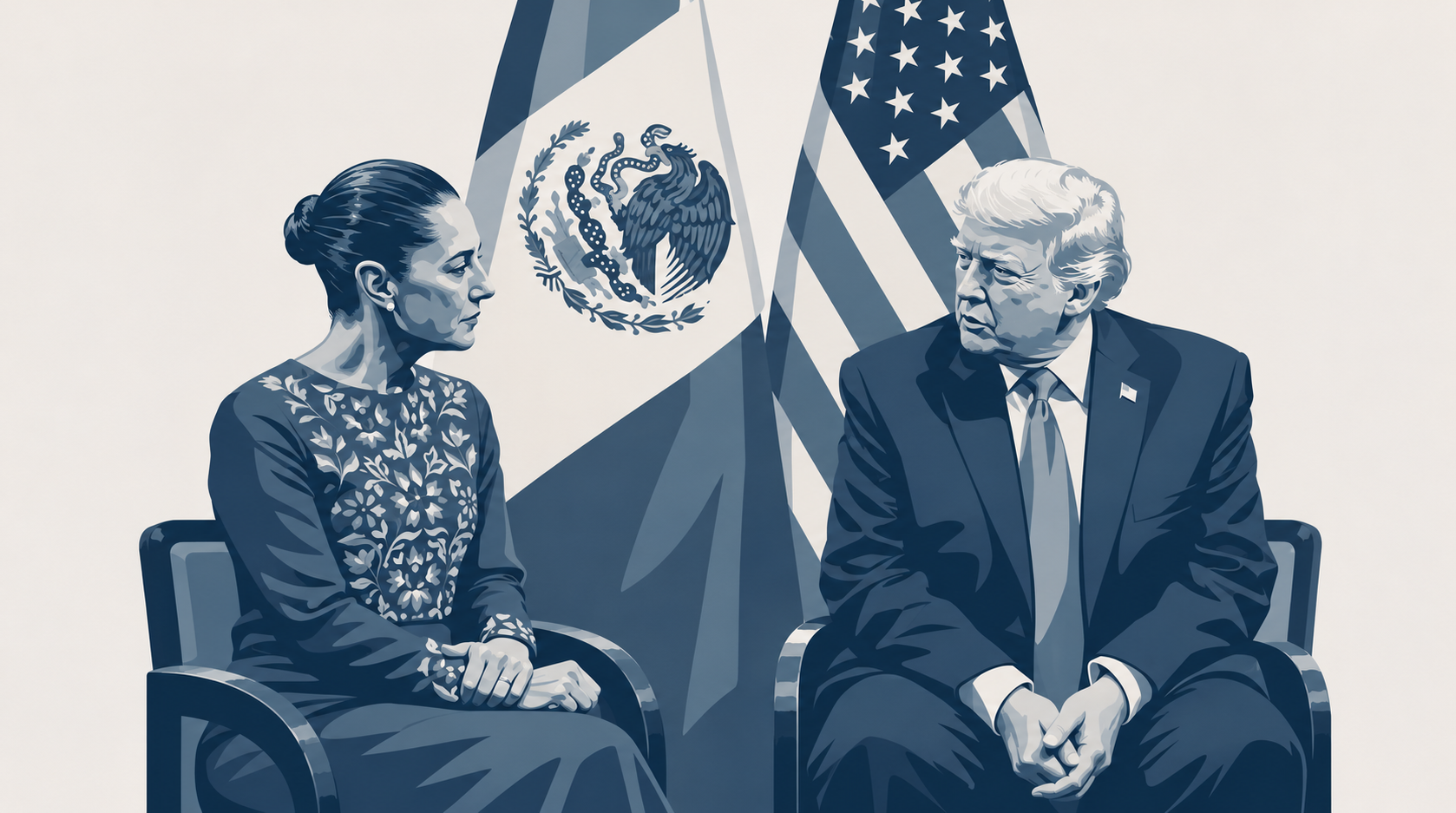
On 10 March, three days after Donald Trump launched it, President Claudia Sheinbaum dismissed Mexico’s absence: “We were not invited, but we did not need to be, because we already have an agreement with the United States”. The next day Trump said he thought Mexico had been asked to join but “maybe they didn’t come”. The State Department added that the door was not closed.
Sheinbaum’s retort implies a privileged relationship with Washington, at least compared with the rest of Latin America. That privilege lets Mexico pursue “cooperation without subordination” through agreements that respect its red lines. Joining would look like currying favour, or sharing the ideological affinity of the region’s right-leaning governments. Worst of all, it would suggest tolerance for active US service personnel conducting joint ‘kinetic’ operations on Mexican territory (the Senate has so far admitted US troops only for training), the clearest red line for the administration. Emphasizing sovereignty undoubtedly serves internal political considerations, but the concept has gained resonance because Venezuela, under Delcy Rodríguez, offers an object lesson in what dependence brings.

At the Milken Institute’s Mexico City symposium on October 28th, Foreign Secretary Roberto Velasco offered a defence of this approach. Speaking to Bloomberg’s JP Spinetto, he highlighted what he called “excellent results” from bilateral security cooperation, including an almost 70% decline in fentanyl seizures at the US border, more US investigations into arms trafficking and the arrest of major organised-crime figures in Mexico. He attributed these results to cooperation based on mutual respect, shared responsibility and, crucially, “cooperation without subordination”. For the government, such results help justify working directly with Washington rather than joining a US-led regional coalition. But they do not resolve the question of whether Mexico can continue setting the terms of that cooperation as US demands grow.
The audience mattered. Now in its third year, the Milken Institute’s Global Investors’ Symposium has become a regular stop for senior Mexican officials making their case directly to the investors whose capital the country is trying to attract, and this year’s theme, “Capital in a Changing World”, could hardly have been more apt. Ahead of the event, the Institute’s Laura Deal Lacey said long-term investors “remain confident in Mexico”, while warning that the next 18 to 24 months could be “bumpy as trade relationships are tested”. That is, in effect, the bet behind Mexico’s foreign policy: that steady results on security will keep both Washington and investors on side while the USMCA review plays out.
The risks of going it alone
Mexico’s absence is not a hedge. It is not seeking an alternative to its relationship with the US, nor does its absence from the coalition signal a break or realignment like Canada’s, which is exploring more formal ties with the EU and has called for a coalition of middle powers. Nor is it part of a longer policy of hedging, like Brazil’s membership of BRICS or its construction of regional influence in South America.
Lula’s re-election in Brazil on 25 October relieves some of the pressure Mexico might have faced as the region’s only major holdout, had Flávio Bolsonaro won and kept his pledge to join the Shield. The region’s two largest economies will now stay out, though so far there is no sign that this will produce a common alternative position. On the other hand, the setback to Trump’s plans might make Washington keener to reassert its supremacy in the region by extracting concessions through other means.
What the midterms change
The Democrats’ sweeping victory in the 3 November midterms could cut both ways for Mexico. Trump and the Republicans have two years to reflect on why they lost, and tariffs that raise prices for American consumers are hardly an attractive platform for the 2028 presidential election. This may encourage a more pragmatic approach to trade and the USMCA negotiations, particularly as Congress becomes more assertive. But a president frustrated by domestic opposition may also look abroad for victories, especially in areas where he retains considerable executive freedom. Tougher action against Mexican cartels enjoys bipartisan support and offers Trump an opportunity to demonstrate resolve without directly raising consumer prices. Mexico could therefore face a less confrontational Washington on trade but a more demanding one on security. The midterms have changed Trump’s political incentives, but not necessarily reduced Mexico’s vulnerability.
Restraint, not leverage
Mexico’s privileged relationship with the US comes from the inertia of their geographic proximity, mutually beneficial commercial integration, demographic exchange, the institutional framework of the USMCA and shared security concerns. Destabilising Mexico would be an act of self-harm for the US, yet, other things being equal, Mexico’s vulnerability to the US remains much greater. Inertia buys restraint from the US, not any new leverage for Mexico to negotiate and defend better terms, more security or even a more predictable relationship.

Mexico, on its own, has no framework or metric for determining success in its cooperation with US objectives. Sending 92 prisoners north and imposing tariffs of 5% to 50% on imports from non-treaty countries, notably China, earned praise from Homeland Security Secretary Markwayne Mullin, yet the USMCA was not extended on 1 July. Meanwhile, Washington’s demands have grown from 54 to almost 90 points (a Mexican undersecretary calls them the original topics unfolding) and cars still pay 25%. Argentina, by contrast, got a $20 billion relief package.
Given this context, Washington can be expected to keep making ad hoc demands that Mexico will try to accommodate. The 2027 budget proposal hints at one area: higher defence spending. Colby’s criticism of those spending under 1% of GDP could set the benchmark, and an increase might carry a double advantage: it could be spun as a victory for Trump’s security policy and as a way of narrowing the US trade deficit with Mexico, if some of the money went on US contracts.
Taking the initiative
Velasco also offered a glimpse of a more active foreign policy at the Milken event, though not one designed to counterbalance the US. He defended Mexico’s tradition of viewing states as legally equal rather than through the prism of competing great powers, while acknowledging the need to diversify its international relationships. The Foreign Ministry has created an economic diplomacy unit to attract investment, and Velasco described closer engagement with Latin America, Asia and the Middle East. He pointed to improving relations with Brazil, including plans for a Pemex, Petrobras strategic alliance, and a desire to maintain constructive political dialogue with China. But he was explicit that diversification was not intended to replace Mexico’s North American relationship. This suggests greater diplomatic activism, rather than a fundamental change in Mexico’s geopolitical positioning.

Mexico’s foreign-policy reticence leaves it vulnerable to pressure. A new coalition is not Mexico’s aim, though there is an argument for one. Velasco was in Brasília in August and in Guatemala in October, and a binational commission with Guatemala meets in Mexico City on 27 November. President Sheinbaum is due to attend the APEC summit in Shenzhen on 18, 19 November. More active diplomacy may broaden Mexico’s options, but unless it creates real leverage with Washington, it will do little to change the terms of the relationship.