Mexico Public Affairs Chatter, October 13, 2026

Guadalajara’s tap water reaches the street
A march of at least 10,000 people over the poor quality of Guadalajara’s water has ended in clashes at the governor’s door. On Sunday, riot police used water hoses and tear gas to break up the protest when it reached Casa Jalisco, the residence of Governor Pablo Lemus, while some protesters threw dirty water, paint and bags of rubbish at the officers. The state reported 39 arrests and 59 injured: 31 civilians and 28 police officers. Since March, over 300 neighbourhoods in the metropolitan area have reported their water smells of sewage, though the city has had pervasive issues with water quality for years. Samples tested by the Centro de Justicia para la Paz y el Desarrollo (Cepad) found heavy metals and faecal matter, and no sign of chlorination. Lemus has acknowledged the crisis but offered no quick fix: on expert advice, the city will stop drawing on the Las Pintas dam and the old Chapala system, which means cleaner water but less of it for months, leaving some neighbourhoods dependent on water trucks.

The story travelled not only because of the size of the protests, but because of who governs Jalisco. Lemus belongs to Movimiento Ciudadano (MC) and the crackdown gave Morena an opening it did not waste.
On Sunday night Morena issued a statement saying repression should never be a government’s answer to social discontent and that public rejection of further water privatisation must be heeded. The Comisión Nacional de los Derechos Humanos (CNDH) called on the Jalisco authorities to respect the rights to protest, free expression and peaceful assembly. On Monday morning the president joined in.
‘It is their responsibility to explain why they used water and tear gas,’ Claudia Sheinbaum said at her press conference, adding that police must distinguish between containing a risky situation and repressing a demonstration. She asked Lemus to clarify the status of those detained or reported missing, then turned to the policy dispute underneath. Lemus has proposed a construction, maintenance, rehabilitation and operation (CMRO) model of the kind used for motorways. Sheinbaum replied that water is different because of who operates it, warned that some financing schemes can lead to private operation of the service and said the state should first take the matter to the Comisión Nacional del Agua (Conagua). She also described the supply problem as a municipal one.
Lemus answered within hours. He said the march had been peaceful for more than two hours until a group of about 400 people arrived and, in his account, provoked the clashes and attacked police, some of them hooded and carrying stones, pipes, hammers, nail-packed firecrackers and gas canisters. Lawyers and relatives gathered outside the state prosecutor’s office told a different story, insisting the protest had been peaceful and that more people were being held than the state had acknowledged. The Universidad de Guadalajara and the Instituto Tecnológico y de Estudios Superiores de Occidente (ITESO) said some of their students were among those detained. Lemus said twelve detainees had been released, asked the state prosecutor to review each remaining arrest and promised that videos of the protest would be examined for abuses. The Comisión Estatal de Derechos Humanos Jalisco (CEDHJ) has opened an ex officio investigation, and Lemus pledged to cooperate. He also said he would neither privatise water nor raise tariffs.
The clash runs deeper than a quarrel over who answers for the police. On 30 September Alicia Bárcena, the environment secretary, used the morning press conference to present MXN20 billion of federal investment in drinking water and sanitation. It was centred on other basins, and the absence of Guadalajara’s supply system from the priorities did not go unnoticed in Jalisco. The grievance was older still: in July Lemus had complained that the state had received ‘zero pesos, zero cents’ from the federal government for any infrastructure project, whether roads or water. Left without federal money, the governor turned to his own. He sent the state congress an initiative for a 31-kilometre replacement aqueduct from Lake Chapala, financed through a CMRO scheme, and insisted it would not hand the service to private companies. Seen from the Palacio Nacional, a contract in which a private party builds and then operates water infrastructure looks like privatisation under another name, and Sheinbaum said as much on Monday. Each level of government now holds a veto over the other: the federation through concessions and Conagua’s approval, the state through the project and its financing.
The broader problem is that Guadalajara’s water crisis exposes a familiar weakness in Mexico’s federal system: responsibilities are divided, but accountability is not. The municipalities are responsible for supplying water, the state for major infrastructure, and the federation controls key concessions and most of the funding. Each can point to the others when things go wrong. The dispute over private participation makes it tougher to work out how to finance decades of neglected infrastructure. For Lemus, the political danger is that a water-quality crisis becomes a water-supply crisis as well. For Sheinbaum, it is that opposition to private financing leaves the federal government under pressure to spend more public money, when there is not enough as things stand.
One house, one key
A single house in Mexico can have two or even three official floor areas: one in the deed, another in the municipal cadastre and sometimes a third in the public property registry, where an extension built a decade ago may never have been recorded. Notaries lose weeks reconciling the figures, and fraudsters exploit the gaps to sell the same property twice. The Chamber of Deputies has now approved the Ley General para el Fortalecimiento y Armonización Catastral y Registral, which President Claudia Sheinbaum sent to Congress in September to give every property in the country a single identity. The vote came in the early hours of 7 October after a session of more than twelve hours. The bill passed 324 to 107 in general and 299 to 92 on the amended articles, and now goes to the Senate.
Each property will receive a Single Cadastral Key (Clave Única Catastral), an identifier that stays with it when it changes hands. A Single Cadastral and Registry Certificate (Cédula Única Catastral y Registral) will link municipal cadastral data to the folio real, the property’s record number in the public registry. The law creates a National Cadastral Plan, a National Registry Plan and two digital platforms, one for municipal cadastres and one for public property registries. Users will log in through Llave MX, the federal digital identity system, and every electronic action must be recorded in a chronological, unalterable and auditable log. The Agencia de Transformación Digital y Telecomunicaciones (ATDT) will build and run the platforms, including electronic payment modules for tax procedures. The Secretaría de Desarrollo Agrario, Territorial y Urbano (Sedatu) will issue guidelines and, subject to the approved budget, administer federal funds for the existing programme to modernise property registries and cadastres. During the vote on individual articles, deputies accepted an amendment from Morena’s Elena Edith Segura allowing the authorities to coordinate with the Instituto Nacional de Estadística y Geografía (INEGI), which will supply technical data on how municipal cadastres operate so that priorities and resources can be set. Implementation will follow a calendar, to be published in the Diario Oficial de la Federación (DOF), that takes account of the technological lag in many municipalities.
The floor fight was over the predial, the municipal property tax. The committee report argues that municipal revenue will rise because updating cadastres and registering missing plots widens the tax base. The Partido Revolucionario Institucional (PRI) branded the law Morena’s predialazo, a property-tax hike by the back door. Deputy Arturo Yáñez argued that a higher assessed value means a bigger bill, even if the rate stays the same. The party’s coordinator, Rubén Moreira, conceded that the articles do not directly order a reappraisal but said the idea appears in the Executive’s explanatory statement (exposición de motivos). For the Partido Acción Nacional (PAN), Roberto Sosa Pichardo said the law hands the Federation and the ATDT powers that belong to states and municipalities, in breach of the municipal autonomy guaranteed by Article 115 of the Constitution. The opposition also complained that the platforms come with no dedicated federal funding. The PAN, PRI and Movimiento Ciudadano (MC) voted against the bill. Lilia Aguilar Gil of the Partido del Trabajo (PT) was the only abstention; the other 39 members of her group voted in favour.
Morena said the law brings no immediate or abrupt rise in the predial, only mechanisms to collect it more efficiently and close loopholes, and cited a non-payment rate of around 52 per cent. The PT’s Ricardo Mejía stressed that setting and collecting the tax remains a municipal and state power. The committee had already blunted some of the centralisation charge: it renamed the proposed National Cadastral Platform the Municipal Cadastral Platform and left registry data under the exclusive control of each registry authority. The PT defended the single key as a CURP for every property (a reference to the personal identity code held by every citizen and resident) and as a safeguard against double registration. It also acknowledged that many local governments avoid collecting the predial for fear of a backlash at the polls. Deputy José Luis Montalvo cited figures from the Instituto Nacional del Suelo Sustentable (INSUS) and INEGI showing more than 24 million properties held informally and one in four homes without a public deed.
For owners, the practical effect depends on what local authorities do with better data. Where records underestimate the size of a property, municipalities could adjust the tax under their own fiscal laws. The new law and higher property-tax bills are therefore linked, but one does not automatically follow from the other. Practitioners, meanwhile, see a wider prize. Real-estate specialists were calling for interoperable registries months before the bill arrived. They now argue that valuers, developers, proptech firms and anyone settling an estate stand to gain, and that a single key tied to the folio real will make doctored or duplicated records harder to slip through unnoticed.
The more fundamental question is whether Mexico should rethink the way property taxes are collected, rather than simply improve the records on which they are based. Mexico collects only around 0.3% of GDP in property taxes, exceptionally little by international standards, and collection is heavily concentrated in a handful of relatively prosperous states and municipalities. Poor records are only part of the problem; weak administrative capacity, political reluctance to enforce payment and uneven incentives matter just as much. One proposal is to federalise collection, with revenues returned to states and municipalities through a formula that rewards investment rather than simply increasing unconditional transfers. Former Hacienda officials have estimated that such a reform could potentially lift property-tax revenues to 2, 3% of GDP, although that is an ambitious theoretical estimate rather than a forecast. It could help strengthen Mexico’s strained public finances while reducing the temptation to squeeze more revenue from the minority of property owners who already pay. But it would require a fundamental renegotiation of Mexico’s fiscal federalism, not merely a better database.
There is, however, a powerful argument for keeping the predial local. Unlike income tax or VAT, property tax is directly connected to the public services residents experience every day: street lighting, drainage, local policing, road maintenance and public spaces. It creates a tangible link between what citizens pay and what they expect from their local government. Federalising collection could weaken that accountability, reinforcing a system in which municipalities depend on transfers from Mexico City rather than answering to their own taxpayers. It might also deepen the imbalance between prosperous municipalities with strong tax bases and poorer ones unless redistribution is carefully designed. The real challenge, then, is to combine national standards and better enforcement with incentives for local governments to collect and spend responsibly. A single property register could provide the foundation for that reform, but it cannot resolve the underlying political dilemma: how to raise more revenue without further weakening the relationship between local taxation, local services and local accountability.
The judiciary files its first maintenance request
A year after Mexico’s first popularly elected judges took office, the judiciary has sent the government a fix-it list. On 6 October the four bodies of the federal judiciary handed the Presidency’s Legal Counsel, Luisa María Alcalde, a joint reform proposal to amend the Organic Law of the Federal Judiciary and the Amparo Law. Her office has since folded it into a wider draft that also amends the general electoral law and the recall law. The draft would start the next judicial selection process in April and hold the recall referendum on the first Sunday of June in the fourth year of the presidential term, alongside federal or local elections.

Most of the changes are procedural. The Senate would issue its general call no later than 30 April of the year before each election, and selection committees would be named within fifteen days. A coordinating commission would apply the same evaluation rules to every candidate, whichever branch nominates them. The Judicial Administration Body would remain the overall budget integrator, but the Court, the Electoral Tribunal and the Disciplinary Tribunal would become spending units with their own administration offices. The Court would also gain jurisdiction to settle disputes between judicial bodies, and its chambers would have to follow criteria set by the full bench, without the power to create binding precedent.
The Senate chose its words carefully. Higinio Martínez, the chamber’s president, said ‘reality tells us we need to look for some adjustments’, while denying that Congress had erred in approving the judicial reform. He defended its central aim of widening citizen participation in choosing judges and said he would wait for the assessment of those who now run the judiciary. He added that he had not seen the package and did not know when it would reach Congress.
Outside Congress, the National Association of Circuit Magistrates and District Judges of the Federal Judiciary (JUFED) has been keeping a different ledger. It cited the first Judicial Monitor from Data Coparmex, the research arm of the Employers’ Confederation of the Mexican Republic (Coparmex), which surveyed 3,721 member companies. Of these, 67.8 per cent reported a negative impact on investment or expansion decisions and 28.8 per cent had reduced or postponed projects in Mexico. Some 55.9 per cent perceived less certainty over property protection, contract enforcement and access to amparo, against 3.3 per cent who saw an improvement. Nearly half had already adjusted their legal-protection strategy through contract clauses, arbitration, insurance or litigation plans. JUFED also noted that the Business Coordinating Council (CCE) and the Private Sector Economic Studies Centre (CEESP) have estimated that the popular election of judges could reduce GDP growth by up to one percentage point. Across the border, the Office of the US Trade Representative (USTR) lists regulatory certainty for investment among its concerns about Mexico in its 2026 National Trade Estimate.
The do-not-call register gets teeth
The Senate has voted unanimously to amend the Federal Consumer Protection Law and stiffen sanctions on companies that call consumers for commercial or advertising purposes without their consent. Companies that breach the prohibition would face fines of roughly MXN56,000 to MXN2.3 million, against a current minimum of MXN760 for the same conduct. The bill now goes to the Chamber of Deputies.
The initiative, presented by Senator Mayuli Martínez Simón of the National Action Party (PAN), amends Articles 18 Bis and 127 of the law. It also closes a familiar escape route: companies could no longer avoid responsibility by arguing that the calls were made by a third party or a contracted call centre. The prohibition covers repeated and persistent calls and advertising messages sent without consent, and the obvious targets are the industries that live on outbound sales: financial services, credit cards and insurance.
The committee report is frank about the diagnosis. The root of the problem, senators wrote, was never the lack of a registry against commercial calls but the lack of penalties strong enough to deter the practice. Mexico has had a public do-not-call register for years, and the numbers show how little respect it commands: the report places Mexico among the five countries with the most unwanted calls, with an average of 20 to 25 spam contacts per user each month.
The Senate’s text will not land on an empty desk in the lower house. In March, Ricardo Monreal, Morena’s coordinator in the Chamber of Deputies, presented his own initiative to amend the Federal Consumer Protection Law and the Law for the Protection and Defence of Financial Services Users to curb advertising calls, spam and telephone fraud. His text would replace the current model of tacit consent with one of express consent: users would receive marketing only after giving prior, verifiable agreement, with free and accessible means to withdraw it at any time. Companies and financial institutions could not make accepting advertising a condition for signing or renewing a contract, and accepting terms and conditions or a privacy notice would not count as consent. That initiative is still in committee, so deputies will now have two texts before them: the Senate’s, built around liability and the size of the penalty, and Monreal’s, which targets the consent model that allows the calls in the first place.
Mexico Softens Tourist Tax Hike, but Raises the Army’s Share as Tourism Weakens
Mexico’s Congress has softened a proposed increase in the tax paid by foreign tourists following complaints from the industry, but the revised levy remains substantial and will channel a greater share of revenues to the military. On Monday, the Chamber of Deputies’ Finance Committee approved an amendment to the 2027 Federal Fees Law (Ley Federal de Derechos), reducing the proposed increase in the non-resident visitor fee from 35% to 17.8%. The charge would rise from MXN988 (US$54) to MXN1,158 (US$63), rather than the MXN1,334 originally proposed. The committee approved the amended bill by 22 votes to nine. It now proceeds to the full lower house.
The concession came with a change in allocations. The share of revenues allocated to the Defence Ministry (Sedena), which administers the Tren Maya railway and Felipe Ángeles International Airport (AIFA), will increase from the originally proposed 50% to 57%. The Immigration Institute’s (INM) allocation falls from 26% to 15%, while the Treasury’s share rises from 24% to 28%. Opposition legislators questioned why the military should receive more money while immigration authorities receive less.
The timing comes as Mexico’s tourism industry is showing signs of weakness, particularly in established beach destinations. Cancún airport traffic fell nearly 12% in September, while Tulum and Puerto Vallarta have also struggled. The industry faces a combination of pressures: a peso that has appreciated until early September by around 12%, making Mexico more expensive for foreigners; concerns about insecurity and cartel violence; unusually heavy sargassum on Caribbean beaches; and persistent complaints about expensive taxis and transport restrictions in tourist destinations. Perhaos mos timportnatly air travel has also become more costly, with higher fuel costs putting pressure on fares and reduced airline competition limiting choices on some routes. US airline capacity to Mexico’s Caribbean destinations is projected to fall 12.8% in the final quarter of 2026.
The increase is unlikely, by itself, to determine where most international tourists spend their holidays. But it adds to the cost of visiting Mexico when parts of the industry are already losing competitiveness. More fundamentally, it raises a question about tourism policy: why increase charges on visitors to established destinations to help finance government infrastructure projects, rather than prioritise investment in the destinations generating the revenue?
Chatter Box

Resistance Day, extended deadline
President Sheinbaum has extended the consultation on the General Law on the Rights of Indigenous and Afro-Mexican Peoples, the secondary legislation for Article 2 of the Constitution. The government had hoped to send the bill to Congress on 12 October, the Day of Indigenous Resistance. Instead, Sheinbaum told indigenous and Afro-Mexican representatives at the National Palace that it would not be presented until the peoples themselves said it was ready. ‘We want to produce a consensus proposal, not one of dissent,’ she said at her morning press conference. No new date has been set.
The Presidency presents the extension as a response to a request from Yaneth Cruz Gómez, a Tojolabal representative from Chiapas, who also handed over her own draft. Media outlets have been reporting for weeks about complaints and amparo claims filed by several communities against the consultation, and reports that participants at the Congreso Nacional Indígena (CNI) assembly rejected the initiative and the forums held on it.
Sheinbaum said the law should incorporate existing programmes such as the regional justice plans, as well as traditional communal property. That last item is the one to watch, since the rules on communal land and consultation shape mining, energy and infrastructure projects. The Instituto Nacional de los Pueblos Indígenas (INPI), which runs the process with the Consejería Jurídica del Ejecutivo Federal, says 77 regional assemblies and 19 working groups have so far produced 2,287 contributions.
A decree for safe screens, with the details still on the slides
President Claudia Sheinbaum has presented a draft decree banning violent content directed at minors on social networks. At her morning press conference on 9 October she said it would be published in the Diario Oficial de la Federación (DOF) this week as a binding instrument. Platforms would have to remove content that generates or promotes hate speech, violent extremism, sexual abuse, exploitation or violence, suicide, deliberate self-harm, eating disorders, school violence, harassment and cyberbullying, unlawful conduct and explicit sexual material. They would also have to report any violent content they identify to the Secretariat of Security and Citizen Protection (SSPC) and the National Guard. The text will be reviewed with specialists and platform representatives.
The most contentious element is the one that decides everything else: the definition of ‘digital platform’ shown on the slides. Drawn broadly, it reaches far beyond social networks to any service where users post, comment or send messages, making each of them answerable for removal and for reporting to the security authorities. Sheinbaum said removal should be immediate and that the days before publication were meant to give platforms the chance to ask for more time. José Antonio Peña Merino, head of the Agency for Digital Transformation and Telecommunications (ATDT), said the decree seeks to improve existing takedown procedures and make reporting to the authorities easier. The scope, deadlines and any sanctions will only be known once the decree appears in the DOF, and companies would do well to wait for it. Regulation in Mexico still arrives by decree; it has yet to arrive by PowerPoint.
Mexico City’s rent cap already exists
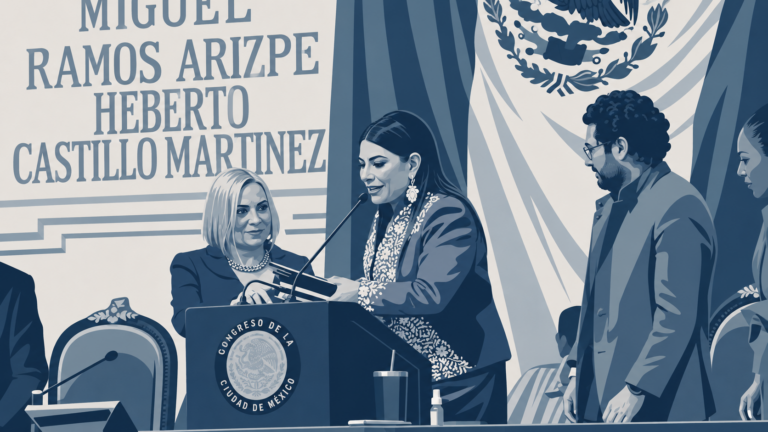
Mayor Clara Brugada has announced that she will present the Fair, Reasonable and Affordable Rents Law to the Mexico City Congress on 14 October, when she delivers her second annual report to the full chamber. Speaking on World Habitat Day, the head of government said the law would keep rent increases at or below the previous year’s inflation and create a Tenancy Relations Ombudsman to regulate the rights and obligations of landlords and tenants alike. ‘We cannot have evictions where people end up on the street,’ she said.
The cap itself is hardly new. The city’s Civil Code already limits increases to the previous year’s inflation as reported by the Banco de México (Banxico), which set this year’s ceiling on renewals at 3.69 per cent, and the Supreme Court of Justice of the Nation (SCJN) upheld the cap as constitutional on 18 February. A companion amendment submitted in April would write the cap into the city’s constitution and oblige the government to build more social housing.
Daniela Álvarez of the National Action Party (PAN), who chairs the committee that must process it, has called it unviable; Ángel Tamariz, a Morena deputy in the city Congress, replied that the law ‘is going to advance’.
With the ceiling settled in the courts, the fine print moves elsewhere. Landlords and the property industry will read the draft for the ombudsman’s powers, the rules on eviction and any new obligations on lessors, since those will determine the real cost of letting in the capital. Organisations from the Urban Popular Movement are also pressing for changes to the Expropriation Law to add grounds tied to social or emergency situations, a demand the property sector will watch even more closely.
IMSS workers take the pay fight to the streets
Workers at the Instituto Mexicano del Seguro Social (IMSS) have called a national march for 13 October, from the Centro Médico Nacional Siglo XXI to the Palacio Nacional, to protest against shortages of staff, medicines and supplies and to demand a bigger pay rise. Weekend protests reached 12 states, according to government monitoring. On 14 October union members will vote on the proposed 6.8 per cent increase, which IMSS director Zoé Robledo says breaks down into 2.9 per cent on base pay and 3.9 per cent in benefits. Dissidents are also demanding the removal of Rafael Olivos Hernández, secretary-general of the Sindicato Nacional de Trabajadores del Seguro Social (SNTSS), and an extraordinary congress to elect new leaders. Robledo said he respects both the protests and the vote, and asked demonstrators to keep access to hospitals clear. Deputies from the Partido Acción Nacional (PAN) have called for his resignation.
The revenue package gets a week, and a deadline
The Chamber of Deputies will spend this week on next year’s revenue bills and tax changes, according to Ricardo Monreal, Morena’s coordinator in the chamber. The Finance and Public Credit Committee meets on Monday to discuss and vote on its reports on the Federal Duties Law, the Income Tax Law and the Federal Revenue Law, which have already been circulated to members. Floor sessions are scheduled for Tuesday and Wednesday, with Thursday held in reserve. Monreal said the chamber wants to finish early so that the Senate has time to do its part, and put the legal deadline at 20 October. The Revenue Law requires approval from both chambers, whereas the Expenditure Budget belongs to the deputies alone. On 16 October, Economy Secretary Marcelo Ebrard will appear before the joint economy committees, where he is expected to report on the USMCA review and the performance of the economy.