Mexico Public Affairs Chatter, November 10, 2026

Cleaning Corruption: ‘Turpentine, Not Fabric Softener’
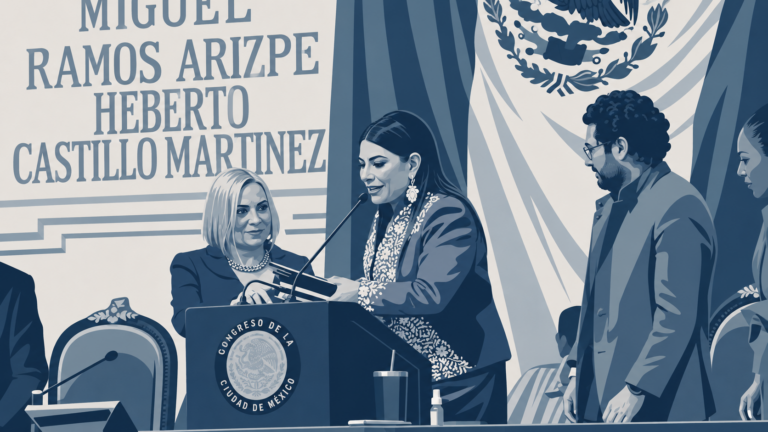
Senate President Higinio Martínez has received a package of anti-corruption proposals for debate in an extraordinary session of Congress in January. Morena deputies developed the proposals with civil society groups, business organisations and public bodies. Accepting them on Monday morning, Martínez said the country has failed to end corruption, which he called its main problem, and argued for a deep clean, done with turpentine rather than fabric softener. He has pressed the President for tougher measures since Guadalupe Taddei resigned as head of the National Electoral Institute (INE) on 26 October amid scrutiny of contracts awarded under her leadership.

Senator Higinio Martínez. (Photo: Comunicación Social Senado)
The most telling part of the package is who worked on it. Alongside Morena deputies, the group includes the Mexican Bankers’ Association (ABM), the Judicial Administration Body (OAJ), the National Antitrust Commission (CNA), the University Programme for Development Studies (PUED) at the National Autonomous University of Mexico (UNAM) and the Centre for Economic Research and Teaching (CIDE). Alfonso Ramírez Cuéllar, the Morena deputy who delivered the proposals, said Mexico needs a new anti-corruption system, a rebuilt audit and oversight system and redesigned state anti-corruption prosecutors’ offices. He also called for reform of the Criminal Code and a review of legislators’ procedural immunity, or fuero. Asked whether that meant a constitutional amendment to abolish it, he said yes. He added that the final number of initiatives and reforms has yet to be settled.
Ramírez Cuéllar wants a national conversation on the proposals that also covers whatever the executive submits, so that Congress can deal with both in January. The executive’s package is a separate text. On 22 September President Sheinbaum described it as essentially administrative. She said it would focus on administrative sanctions, shorter deadlines for resolutions and recovery of damage to the public purse, with nothing touching the Attorney General’s Office (FGR), and that it would arrive in around fifteen days. Seven weeks on, Martínez said on Monday that the President has on her desk a proposal to amend anti-corruption 16 laws and create two new ones.
The same day showed how corruption reaches companies in practice. Reforma, which has seen the complaint, reports that the Ministry of Anti-Corruption and Good Government (SABG) went to the FGR after businesspeople and government suppliers were threatened with documents on the ministry’s letterhead. The documents bore the name and signature of minister Raquel Buenrostro and were used to extract payments. Mauricio Elpidio Montes de Oca Durán, director of criminal and strategic affairs at the ministry’s anti-impunity unit, filed the complaint on 6 August. He acted on an anonymous tip about an order supposedly signed by Buenrostro, who denied writing it.
One forged order, dated 4 June, claimed that Ulises Lara, then head of the FGR’s special prosecutor’s office for relevant cases, had directed an investigation into certain suppliers. It instructed officials to open disciplinary proceedings against any supplier found to have broken the law and to notify the FGR. A caller would then offer, for a fee, to intercede with Lara and halt the investigation. Lara resigned on 14 July, and no public evidence links him to the orders or the extortion. The ministry had warned in July about people posing as its officials, and it insists that no procedure can be suspended through payment.
For business, the stakes run on two tracks. Because the bankers and the antitrust regulator are among the contributors, the private sector has a hand in the congressional text. That text would redraw the audit, prosecution and asset forfeiture rules that reach contractors and suppliers. The executive’s package will decide how quickly administrative sanctions arrive. Two files closer to day-to-day compliance sit outside both packages. The SABG took over data protection when the INAI was abolished, but the government is more than sixteen months late with regulations for the March 2025 data protection law. Companies are still working with the 2011 regulations wherever they do not conflict with the new law. Lobbying still has no statute.
Rules Before Referees
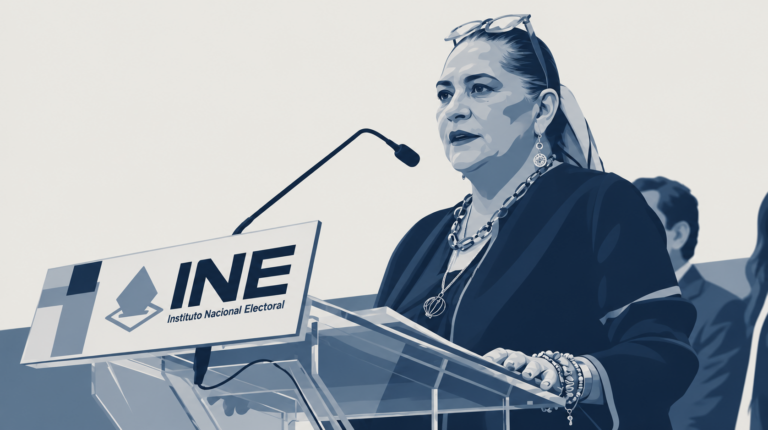
The procedure to replace Guadalupe Taddei as head of the National Electoral Institute (INE) has fallen behind schedule. Under the original calendar, the Chamber of Deputies would have approved the call for candidates on 4 November, installed a Technical Evaluation Committee by 12 November and taken registrations from 9 to 13 November. The vote was postponed when the parliamentary groups failed to agree and the National Action Party (PAN) tabled eight changes to the draft. Ricardo Monreal, who chairs the Political Coordination Board (Jucopo), now expects the plenary to approve the call on Thursday 12 November.

Taddei resigned on 26 October and the corruption scandal has widened. (Photo: INE)
The committee will have five members, two appointed by the National Human Rights Commission (CNDH) and three by the Jucopo. The CNDH has moved first. In a statement dated 9 November, it said it is ready to name its two members once the call is issued, and it published in advance the five conditions they must meet. Its nominees must never have been nominated for elected office. They must never have held leadership posts in national or local parties, or in national or local political associations. They must have a record of defending suffrage, electoral transparency and political rights. And they must have held no post at the INE, or at its predecessor, the Federal Electoral Institute (IFE), in the past 20 years. The Commission says it applied the same criteria in 2022 and in March 2026. It adds that in 2022 it replaced one of its nominees after information came to light that had not been available when it made the choice.
The Commission says it applied the same criteria in 2022, when it replaced one of its nominees after new information came to light.
The statement also says it would be desirable to extend these conditions to the new president. The suggestion is not binding, since the call is the Jucopo’s to write, but it would make the rules considerably stricter. The statement also rejects calls from party figures and legislators for the Jucopo to specify the profile of the CNDH’s nominees or to create a mechanism for objecting to them. It calls these proposals illegal, an attack on its autonomy and regressive. Under the Jucopo’s draft, only women may apply, and the winner will serve a term running to 3 April 2032. Candidates must be over 30, have held a degree for at least five years and have electoral experience. They must also declare potential conflicts of interest and relevant professional, contractual or business relationships. The draft bars anyone who has held party posts, elected office or certain government positions in the previous four years. The CNDH’s bars on party posts and candidacies have no time limit. Its 20-year exclusion of former IFE and INE staff would also remove much of the pool with the electoral experience the draft demands.
After suitability reviews and interviews in early December, the committee is due to send a shortlist of five to the Jucopo by 7 December. Appointment requires the votes of two-thirds of deputies present. If no candidate reaches that threshold, the Constitution provides for the Chamber to draw lots among the finalists. If the Chamber does not hold the draw, the Supreme Court of Justice of the Nation (SCJN) does. Taddei herself was chosen by lot in March 2023.
The CNDH also warns that ‘consensus’ between parties has served to cover partisan carve-ups. Monreal, by contrast, wants the appointment to come out of consensus and will fall back on the governing majority only if talks fail. The PAN wants each finalist’s suitability justified in writing. It also wants the presidency’s powers returned to collegiate decision-making in the General Council, a change Monreal has also floated.
Pemex Brings a Lighter Debt Load to Congress
Pemex director-general Juan Carlos Carpio Fragoso appeared before the Chamber of Deputies’ energy committee on 9 November and reported financial debt of US$77.6 billion at the end of September. That is the lowest level since 2014 and about US$20 billion less than a year earlier, thanks to the federal government bailouts (and sadly not due to cash flow operating profitability after capex over that time period). That said, EBITDA for January to September this year did rise 49 per cent year on year to MXN385 billion as oil prices rose. Federal contributions, which go solely to repaying principal on Pemex’s international market debt, will fall from MXN263 billion in 2026 to MXN81 billion in 2027. Carpio said next year’s maturities of around US$4 billion carry no immediate refinancing risk. The company posted a net loss of MXN10.8 billion in the third quarter, an improvement of close to MXN50 billion on the same quarter of 2025, despite operating profit of MXN98 billion. Carpio attributed the loss to interest, tax obligations and exchange-rate effects.

Carpio (centre) at his appearance before the Chamber of Deputies on 9 November. (Photo: Pemex/X)
Suppliers were among the main lines of questioning. Pemex reported payments of MXN952 billion between 2025 and September 2026. About a quarter of that was financed through a programme with the Ministry of Finance (SHCP) and the National Bank of Public Works and Services (Banobras), and the rest came from Pemex’s own funds. Carpio said 2025 invoices are about 99 per cent settled. Balances from 2024 are still being reconciled and should be cleared during 2027. He said 2026 payments are on schedule, but offered to review specific cases of non-payment. Pemex and the SHCP are preparing a second phase of the programme, with more disclosure of payment dates and amounts. Deputies cited a figure of MXN255 billion. Carpio said this is commercial debt to suppliers, not financial debt, and that its payment is tied to the expected cash flows of the projects it financed.
Carpio acknowledged that payments to main contractors do not always reach subcontractors. He said Pemex is considering contractual obligations to make sure the money travels down the chain. Cases involving small and medium-sized firms in Campeche, Tabasco and Veracruz featured prominently in the questioning.
Pemex has awarded ten mixed contracts for mature fields, and nine are already operating. They have brought in US$103 million in signing bonuses and have potential output of 39,000 barrels a day of liquids and 102 million cubic feet a day of gas by December. Pemex keeps at least 40 per cent of the benefits, and the state retains ownership of the fields. Carpio said private participation in deepwater projects remains under review given the scale of investment involved. Pemex recently signed a memorandum of understanding with Petrobras and is working with Eni and BP to assess long-term exploration opportunities. Petrochemicals and fertilisers will also use mixed schemes, with the aim of quintupling output by 2030.
According to Carpio, the Derecho Petrolero para el Bienestar (Petroleum Levy for Wellbeing) has cut the burden on the value of extracted hydrocarbons from roughly 65 per cent to 30 per cent, freeing money for productive projects. Pemex has also begun a technical assessment of unconventional gas in Coahuila, under conditions set by a committee of specialists from public institutions. A first well will establish whether brackish water unfit for human consumption is available, and whether it has any connection to freshwater aquifers. If that cannot be confirmed, the project will not go ahead. No extraction activity has been announced for 2027, pending the results.
*To read more analysis of the energy sector, watch for Mexico Energy Chatter landing in your inbox tomorrow.
Digital by Decree, Sector by Sector
The digital payments law has been in force since 5 November, and the clock is now ticking on the list that will give it teeth. The Ley de Economía Digital para Pagos Digitales y Electrónicos gives the Ministry of Finance (SHCP) fifteen working days to name the sectors in which digital payment may become the only accepted method. That puts the list due by late November. Sector regulators then have another fifteen working days to set the rules and transition periods, which takes the process into mid to late December. Even in the sectors named, Article 15 allows payment in cash or by cheque when a contingency makes digital payment impossible.
At her morning press conference on Monday, President Sheinbaum said the aim is to make payments safer and that cash will remain in use. She named the first targets:
· Petrol stations, where payment traceability should help curb fuel theft and illegal imports.
· Motorway tolls, which would move to digital payment gradually.
She also announced that the state-owned Banco del Bienestar will soon launch an app so that users can pay without withdrawing cash from an ATM.
Asked about claims that the measure is a tool of political and social control, Sheinbaum rejected them. She pointed to Mexico City’s metro, where replacing paper tickets with card payments raised revenue. She said the government does not expect a wave of amparo claims.
Chatter Box

IMSS workers protested in Mexico City on Monday. (Photo: Cuartoscuro)
IMSS staff march against their own pay deal
Active and retired workers of the Mexican Social Security Institute (IMSS) held their fourth national mega-march on Monday afternoon. An estimated 3,000 people marched from the Centro Médico Nacional Siglo XXI to the Zócalo. They reject the 8 per cent rise agreed between the institute and the union leadership, which is split into 4 per cent on base pay and 4 per cent as a housing allowance, and want a straight 10 per cent on salary. They also demand the removal of Rafael Olivos Hernández as secretary-general of the National Union of Social Security Workers (SNTSS), and action on medicine shortages and understaffing in hospitals. At the Senate, marchers pushed past barriers and had a letter formally received requesting a meeting with Senate President Higinio Martínez. The dispute runs as much against the union as against management, and the organisers have promised further marches.
The INE’s front desk shuts, then reopens
Staff at the citizen service modules of the National Electoral Institute (INE), where voter ID cards are issued, stopped work on Monday. Their spokesman, Édgar Fernández, put closures at up to 95 per cent of modules nationwide, while the INE’s own figure was 64.7 per cent. The workers want a 100 per cent pay rise, from around MXN9,600 a month to the equivalent of two minimum wages. They are also asking for Monday-to-Friday schedules, recognition of seniority and new computers. The INE had offered 6 per cent for FA1-level staff from January 2027. By Monday evening the two sides had agreed to reopen the modules on Tuesday. The INE committed to review a rise above 6 per cent but guaranteed no figure, saying any increase will depend on available funds. The workers have threatened another national stoppage on 25 January, when voter ID registration closes. The budget cut above makes a better offer harder to fund.
Judicial staff appraisals: rewritten in two days, scrapped in four
The performance evaluation rules for career judicial staff, published in the official gazette on 5 November, did not survive the weekend. On 7 November the Supreme Court of Justice of the Nation (SCJN), the Judicial Administration Body (OAJ) and the federal judiciary’s unions agreed to rewrite them. Sanctions would go, dismissal included, as would the extraordinary evaluations that heads of courts could request. Criteria involving subjective judgement would be reweighted. On Monday the OAJ went further and abrogated the rules altogether. Federal courts reopened the same day, after stoppages and protests in at least 17 states.
Couriers close Santa Fe over a number plate
From around 9am on Monday, app-based delivery riders blocked the México-Toluca highway in both directions at Santa Fe. They oppose a proposal by Mexico City’s Ministry of Mobility (Semovi) to register their motorcycles as cargo vehicles with dedicated plates, require special licences and add training. Mobility secretary Héctor Ulises García Nieto had described it as a pilot starting in 2026 and taking hold in 2027. After meeting riders’ representatives on Monday, Semovi suspended the pilot. The Tax Administration Service (SAT) has confirmed that, for tax purposes, these riders remain business earners despite their status as workers under the 2024 labour reform. If the scheme is revived, Semovi would add a third legal identity: freight operator.