Mexico Public Affairs Chatter, November 3, 2026
The Tax Cap Gets a Late Guest List
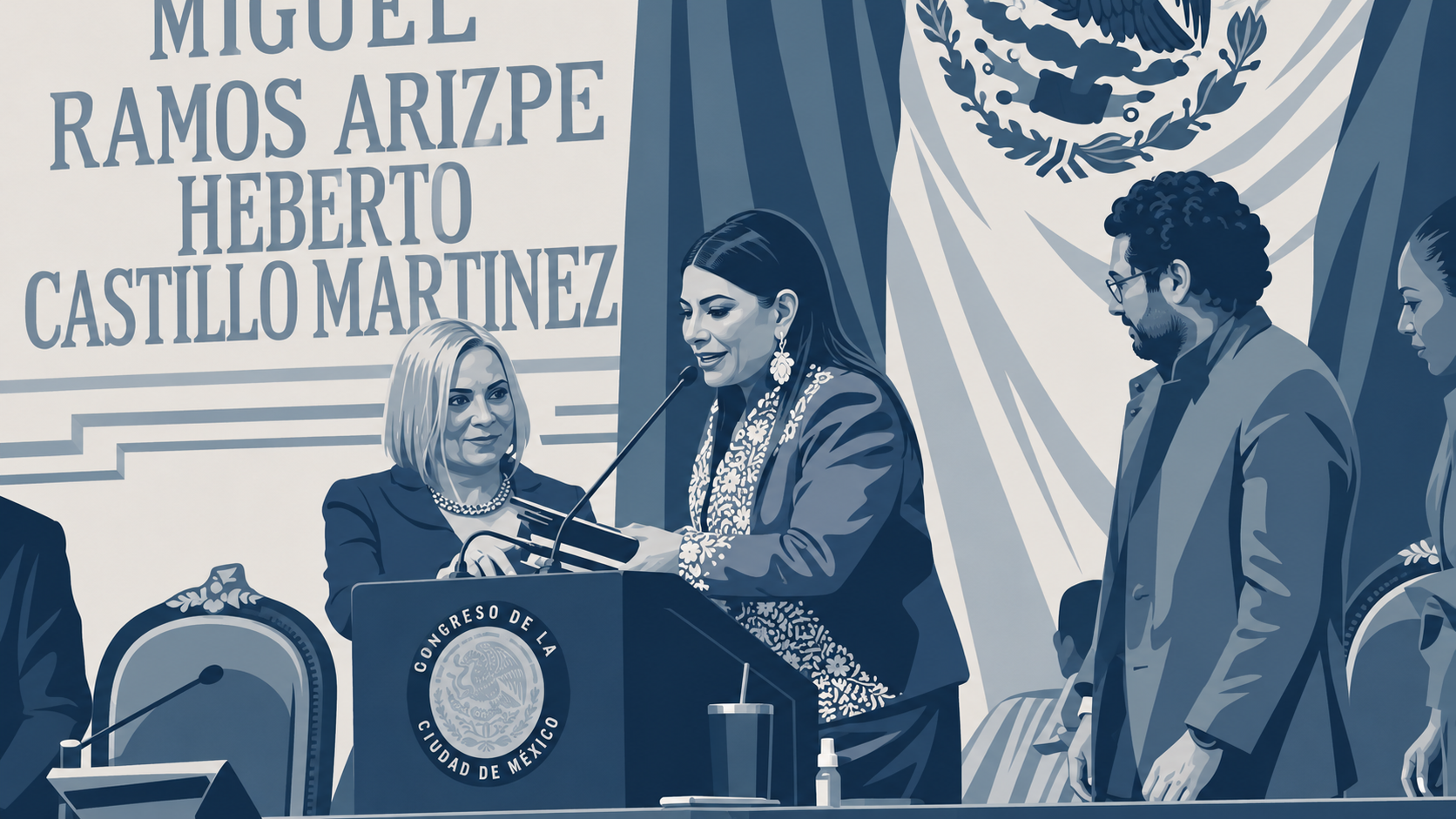
Mexico’s car plants and petrol stations appear to have won a provisional reprieve from the government’s new cap on corporate tax deductions, raising questions on why they and not other affected sectors are being given a free pass. On 27 October, senators rewrote a provision of the 2027 income tax reform and sent the bill back to the lower house, where deputies are due to vote on the change this week. Carol Antonio Altamirano, who chairs the lower house’s finance committee, has refused to fast-track it. The Revenue Law and Federal Duties Law, approved the same night, have already gone to the President for publication.

Senate in session on 27 October. (Photo: Senado.gob.mx)
The cap would apply to companies with taxable income above MXN50m. Firms whose costs exceed 96.67 per cent of income could deduct only up to that threshold, while those below it could deduct 99 per cent of their costs in the year. The disallowed portion could be deducted over 20 years. Past losses could offset no more than half of each year’s profit, and the changes would apply to monthly provisional payments from January. The government presents the measure as a weapon against companies that inflate costs using invoices purchased from shell companies.
The amendment came from Emmanuel Reyes Carmona, who chairs the Senate economy committee, with backing from Ignacio Mier, Morena’s leader in the upper house. Reyes argued that the exemptions, designed for sectors with unusual financial characteristics, had overlooked vehicle assembly, which accounts for around 4 per cent of GDP and is among Mexico’s largest sources of foreign currency. He described Mexico’s 13,000-odd petrol stations as mostly small family businesses with strict volumetric controls and high operating costs. Neither sector escapes income tax; both would simply be exempt from the new cap. PRI deputy Jericó Abramo had already complained that the tax authority was imposing another burden on carmakers, effectively taxing vehicles held in inventory. The revised wording exempts assembly under bonded-warehouse authorisation but leaves domestic vehicle sales subject to the cap. Maquila and export-manufacturing programmes were already exempt.
That leaves dealerships, which buy finished cars and sell them in Mexico, exposed. Diego Camargo, BMW’s chief executive in Mexico, said on 30 October that dealers operate on margins of just 1, 3 per cent and that new showrooms in smaller cities might no longer be viable. The Mexican Association of Automotive Distributors (AMDA) warns that up to 1,000 dealerships and 70,000 direct jobs could be at risk.
But the problem extends well beyond cars and petrol stations. Supermarkets, grocery chains, wholesalers and other retailers frequently operate on similarly thin margins, with substantial inventories and operating costs. Singling out particular industries for exemptions while leaving other legitimate low-margin businesses exposed seems difficult to justify. Rather than selecting favoured sectors, lawmakers should consider broader, objectively defined exemptions or safeguards for businesses able to demonstrate genuine costs through proper accounting and tax records. (Indeed there remains the possibility that such legitimate businesses will be granted a partial reprieve via a subsequent decree.)
The concern is primarily one of cash flow rather than permanently higher taxation. Although the corporate tax rate remains at 30 per cent, companies would pay tax earlier and recover deductions gradually over as much as 20 years, assuming they have sufficient future taxable income. That delay carries a financing cost and erodes the present value of deductions. It could be particularly damaging for retailers, distributors and other businesses with weak balance sheets, limited liquidity or already stretched cash flows. Analysts warn that the resulting pressure could discourage investment, hiring and supplier development. If low profitability is being penalized, the fear is that companies will cut back ambitious growth plans that hurt short term profits, the last thing Mexico needs.
Lawyers preparing amparo challenges will argue that taxing profits a company has not economically earned violates the constitutional principle that taxation should be proportionate to the ability to pay.
One Code, Many Calendars
Civil and family disputes in Mexico will go on being litigated under a patchwork of federal and local procedural rules until at least 2031. On 20 October the Chamber of Deputies voted to push the nationwide start of the National Code of Civil and Family Procedure back from April 2027 to July 2031. Until then, companies, lenders and individuals will face different deadlines, evidence rules and appeal routes depending on where a claim is filed. The bill passed by 367 votes to 60, with only the PRI voting against. The committee had proposed April 2030, and a floor reservation from the leaders of Morena, the PT and the Greens added a further fifteen months. Last week the Mexican Bar Association (BMA) urged senators to reject the delay.
The code was designed to replace the federal procedural code and more than 40 local ones with a single set of rules for divorce, custody, maintenance, inheritance and contract disputes, which make up most of the work of state courts. It grew out of a 2017 constitutional reform and was published in June 2023. So far four jurisdictions have declared it in force: Mexico City, Baja California, Querétaro and Quintana Roo.
Deputies justified the delay by pointing to the state judiciaries’ shortage of courtrooms, technology and trained staff. The BMA counters that a later date fixes none of those problems. In the meantime, state courts will have to run cases under the old rules and the new ones in parallel, and that requires money they do not have. According to JUFED, the association of federal circuit and district judges, the bill puts the national cost at more than MXN10bn, spread between 2027 and 2030. A transitional provision adds that implementation must never reduce the budget for the federal government’s social programmes. Deputies also dropped a proposed general law that would have certified each state judiciary as ready before it switched over.
JUFED ties the delay directly to the 2024 judicial reform. In a statement on 15 October it said that around 60 per cent of qualified local judges had left their posts. It added that Senator Javier Corral, who chairs the Senate justice committee, had acknowledged the learning curve that followed. Rafael Guerra, who presides over both Mexico City’s judiciary and the national commission of state high courts, has said that the two transitions (to the new code and to elected judges) require training for every court official, elected judges included. Mexico City has already moved the second and third phases of its own rollout from 2026 to 2027.
The BMA believes 28 states were preparing to ask for more time. A code meant to end procedural fragmentation would therefore spend the next five years in force in some states and pending in the rest. The association asks that any further delay come with a plan to fix the underlying gaps. As passed, the bill gives the states a new date and a budget ceiling set by what social spending can spare.
Rent Control, with a Consultation Calendar
Mexico City’s Congress will open a public consultation on the Fair Rents bill on 6 November. The bill, which Mayor Clara Brugada sent to Congress on 14 October, would tie the inflation cap on residential rents to the property itself and require every lease to be registered with the city within 30 days of signature. Emilio Guijosa, the Morena deputy steering the bill, has announced that hearings will run until 20 November and written submissions will be accepted until 28 November. The housing and justice committees will then draft their report.

Mayor Clara Brugada appears before Mexico City’s Congress on 14 October. (Photo: Congresocdmx.gob.mx)
The cap is already law. A 2024 reform to the city’s Civil Code limits annual rent increases to the previous year’s inflation, and the Supreme Court upheld it earlier this year. Tenants’ groups say landlords get round it by resetting the rent whenever a new tenant moves in. María Silvia Emanuelli, of the Habitat International Coalition, put it bluntly: nobody respects the rule. The bill’s answer is to attach the cap to the property, so that it carries over from one tenancy to the next. It would also make registration with the city’s digital agency a condition of a lease’s validity. Unlawful increases would bring fines of 100 to 400 UMAs, the official reference unit for fines and charges (roughly MXN11,700 to MXN46,900). Landlords would be limited to a single guarantee and barred from charging tenants for agents’ fees or legal insurance. A new tenancy ombudsman within the Social Attorney’s Office would mediate disputes and impose sanctions.
The market the bill seeks to regulate is a fast-moving target. Advertised rents on the property portal Inmuebles24 averaged MXN21,921 a month in June, up 9.6 per cent from a year earlier, against annual inflation of 3.69 per cent in 2025. About two million people rent in the capital.
Business groups accept the diagnosis but dispute the cure. Federico Sobrino, of the real estate federation FIABCI, said every advantage in the bill goes to tenants. He noted that it offers no tax or other incentive to owners who take on the risk of letting, at a time when squatting cases are rising. On 22 October the Mexico City branch of the employers’ federation Coparmex warned that unbalanced rules would deter investment, shrink supply and push leases into informality. A week later it said it backed the bill’s goal and put forward seven amendments, including tax and administrative incentives for landlords who keep rents reasonable or refurbish run-down buildings. The developers’ association ADI had already argued that capping prices without building more homes leaves the shortage untouched. Jenny Rivas, president of the estate agents’ association AMPI, is more positive and sees value in a register that documents guarantees and obligations.
Chatter Box

US Capitol building in Washington, D.C. (Photo: Reuters)
What Mexico has riding on the US midterms
Voters in the US go to the polls on 3 November to elect every seat in the House of Representatives, 35 of the 100 in the Senate and the governorships of 36 states. Political pollsters and analysts are predicting a strong performance for Democrats. The Washington Post’s Henry Olsen predicts that Democrats will take both chambers, and the latest New York Times/Siena polls show Democrats ahead in all seven races likeliest to decide the Senate, narrowly so in Alaska and Iowa. However, forecasts have been wrong before. The Times itself has warned that Republicans are answering its polls far less often than Democrats, raising the risk of a systematic error like those of 2016 and 2020, and Senate races in particular turn on local candidates and local issues.
For Mexico, the result matters through three issues in the bilateral relationship that run partly through Congress: trade, immigration and security. On trade, analysts expect a Democratic majority to favour keeping the USMCA as a three-country agreement. On immigration, a Democratic House could investigate enforcement, scrutinise its budget and push its own bills, though border control and deportations would stay in the hands of a president who keeps his veto power. Security is the issue least likely to move. Both parties want visible results against fentanyl, money laundering and the officials who protect organised crime. A change of majority would mostly change the instruments of pressure: Republicans would likely keep unilateral military action on the table, while Democrats would probably be more inclined to rely on hearings, financial sanctions and demands for judicial cooperation. Whatever the result, Mexico will need working relationships with both parties on Capitol Hill.
Google and Meta’s dominance of digital advertising has naturally generated some resentment among traditional Mexican media companies that have lost advertising revenues to the platforms, making both companies attractive targets for criticism. Writing in El Heraldo de México on October 27 and November 2, prominent business columnist Darío Celis raised unsubstantiated allegations concerning a possible conflict of interest involving former competition commissioner Alejandro Faya, whose brother reportedly held a senior government-relations position at Meta. (Back in 2021, Cofece’s decided not to continue the investigation in competition barriers in online search, social networks and cloud computing, which never named Meta, but this decision was attributed to the investigation authority not the commissioners). Celis also questioned why Cofece closed its five-year investigation back into 2025 into Alphabet’s Google’s digital advertising practices without sanctions, despite what he described as evidence of market dominance and preparations for a possible fine. On June 13, 2025, Cofece concluded that Google had not unlawfully forced advertisers purchasing search advertising to also buy advertising on third-party websites. Cofece therefore found no infringement warranting sanctions. It was a specific decision about alleged tying practices, not a general finding that Google’s conduct across digital advertising was beyond scrutiny. The decision was made by Cofece, before its replacement by the CNA. Expansión reported that Andrea Marván, whom Celis associated with the decision, had recused herself from that Google proceeding.
Google and Meta together accounted for more than 80 per cent of Mexico’s digital advertising market. It seems reasonable to expect that Cofece’s successor, the Comisión Nacional Antimonopolio (CNA), now operating within the federal government’s administrative structure rather than as an autonomous constitutional body, will continue to face pressure to scrutinise Google / Meta dominance of digital advertising. Traditional Mexican media companies may hope for a more sympathetic hearing. But politics affecting to a greater degree competition policy cuts both ways: Google and Meta are now far more influential electorally than local media is.
Wanted: an INE president (with credibility, but sympathetic to Morena)
The Chamber of Deputies is expected on Wednesday to approve the call for candidates to replace Guadalupe Taddei, who resigned as president of the National Electoral Institute (INE) on 26 October with the 2026-27 federal electoral process already under way. Her successor will serve out the rest of her term, which runs to 2032, and the draft call restricts the post to women. A five-member technical committee will check eligibility, set a knowledge exam, review CVs and interview candidates before sending a shortlist of five to the deputies. Three of its members will be chosen by the lower house’s governing board and two by the National Human Rights Commission. The appointment needs a two-thirds majority. If no candidate reaches it, the winner will be drawn by lot. Ricardo Monreal, Morena’s leader in the lower house, expects a decision around 6 or 7 December. Until then the institute is run by Blanca Yassahara Cruz García, whom the ten remaining councillors unanimously named provisional president on 27 October.
Taddei’s exit followed weeks of revelations about her dealings with José Alfredo Hernández Casillas, legal representative of Cajas Graf, a supplier of electoral materials. On 24 October the Federal Audit Office confirmed it was investigating irregularities in INE contracts worth MXN514m awarded to his companies. Reports of ghost drivers on the payroll followed, and in a recording released last week the contractor complains that Taddei wanted everything for herself. Taddei has denied wrongdoing and blamed former aides. Councillor Rita Bell López has said she received threats after breaking with Taddei’s bloc. Within two days of the resignation, 15 officials from Taddei’s office had quit, among them her chief of staff, Carlos Daniel Luna Rosas, and three directors who appeared in videos with the contractor. The INE has suspended new contract awards while its internal comptroller and the audit office investigate.
The Supreme Court settles the paperwork of corporate distress
The Supreme Court has ruled that a company in bankruptcy keeps its right to go to court, but that the trustee speaks for it. The ruling, issued on 27 October, came in a dispute between Banco Ve por Más and a property developer linked to Rafael Zaga Tawil. The bank, acting through a trust, had sued to enforce a mortgage after the developer defaulted on a loan. Having lost twice in the lower courts, the developer filed an amparo with Zaga Tawil as its legal representative. Backing a draft by Justice Loretta Ortiz, the Court held that the company could not bring the challenge that way. The mortgaged properties belong to the bankruptcy estate, so defending them falls to the trustee, and the company could take part only with the trustee’s authorisation, which it never obtained. The majority found the restriction compatible with the right of access to justice because it protects creditors and keeps the proceedings orderly. A company may still defend on its own any assets that fall outside the estate, namely those that cannot be sold, seized or lost through prescription. Chief Justice Hugo Aguilar voted against. He argued that the draft explained the trustee’s powers without properly testing the bankruptcy law against the Constitution.
Last week the Court also settled where account holders must challenge a bank account freeze: before the district court in the state where the branch holding the account is located. Some circuit courts had allowed challenges to be filed anywhere, on the theory that a freeze affects the account holder across the whole country. The ruling adds to a run of decisions this year in favour of the Financial Intelligence Unit (UIF). In April the Court confirmed that the UIF may freeze accounts in domestic investigations without a court order, and in August it barred judges from suspending those freezes while an amparo challenge is pending.
Government IT suppliers fined for bidding against themselves
The National Antitrust Commission (CNA) has fined nine IT suppliers and their executives MXN67m for rigging federal procurement between 2012 and 2022. It is one of the first major cartel decisions since the CNA replaced the Federal Economic Competition Commission (Cofece). The firms agreed among themselves who would bid, and at what price, in four public tenders and ten restricted invitations to tender. These covered the purchase and leasing of computers, printers, telecoms and security equipment for buyers including the social security institutes IMSS and ISSSTE, Pemex, the water authority Conagua, the housing fund Fovissste, the tourism fund Fonatur and the Economy Ministry.
All nine firms belong to the same corporate group, Grupo Soluciones, and that makes the case legally significant. Companies under common control are normally treated as a single economic agent that cannot collude with itself. The CNA held that by presenting themselves as rivals in a tender, the firms created a false appearance of competition, and that this was itself the offence. It calculated that the agencies paid more than 40 per cent above what they would have paid in a competitive market. It has referred the case to the affected institutions and to the Anti-Corruption Ministry.