Mexico Public Affairs Chatter, November 17, 2026
Sheinbaum Takes Plan México to Shenzhen, with Washington Reading over Her Shoulder
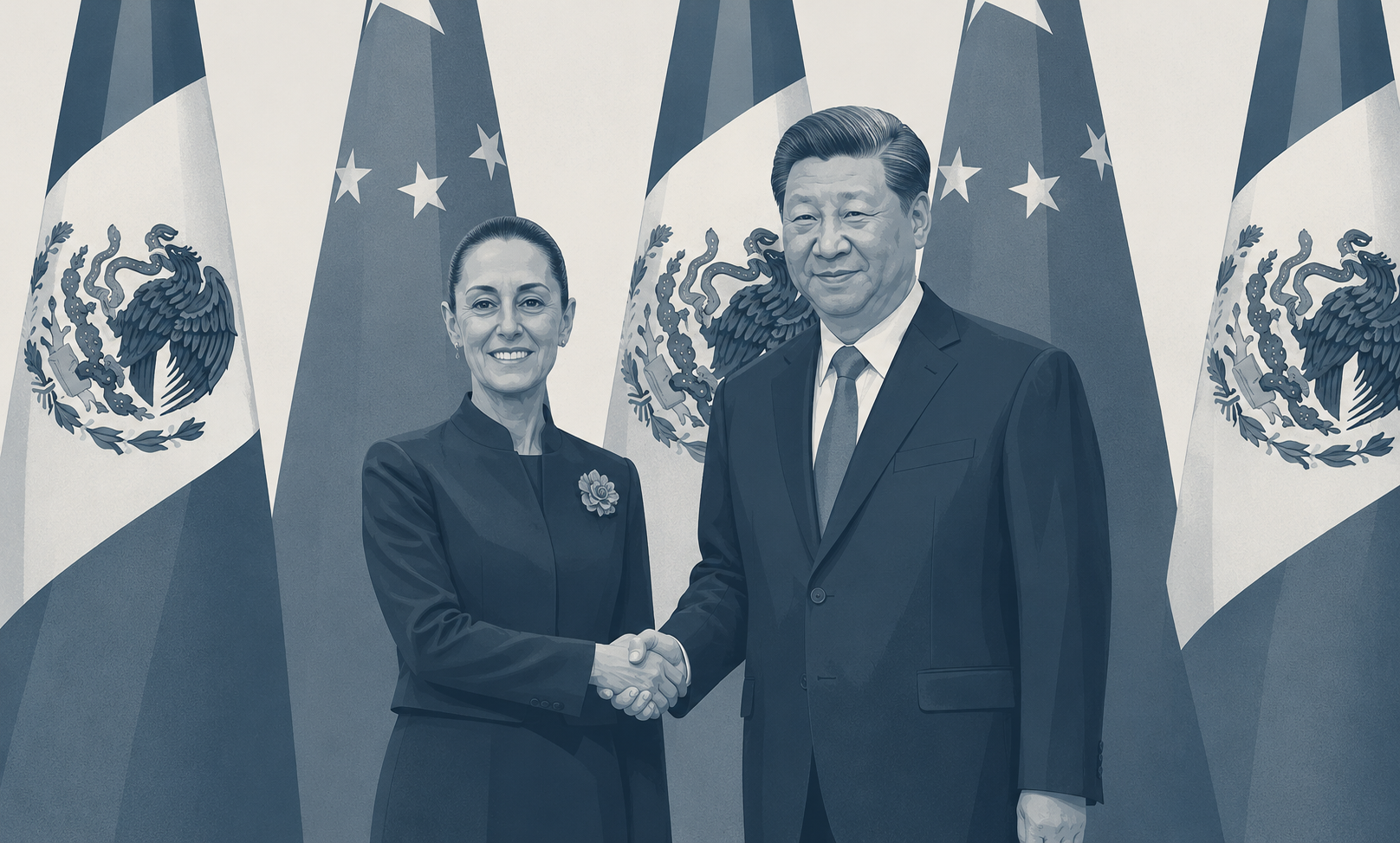
President Claudia Sheinbaum arrived in China on 16 November for the Asia-Pacific Economic Cooperation (APEC) leaders’ summit, marking the first visit by a Mexican president to China since 2017. She met with President Xi Jinping in Shenzhen on Tuesday and told reporters they had discussed raising Mexican exports to China, ‘from avocado to tequila’, and that she had asked for a panda for Chapultepec Zoo as Mexico prepares to mark 55 years of diplomatic relations with Beijing next year. She also invited Xi to the 2028 APEC summit, which Mexico will host.
Leer en español mas abajo

Sheinbaum with Xi Jinping on 17 November. (Photo: Presidencia)
Sheinbaum is travelling with her foreign, economy, environment, energy, health, science and tourism ministers, and with a specific shopping list: Chinese-style ‘smart hospitals’, circular-economy schemes for waste recycling, scientific cooperation and technology transfer for solar-panel manufacturing. Marcelo Ebrard, the economy minister, will stay on after the summit to discuss trade and, more awkwardly, the deficit. Ebrard has already ruled out a free-trade agreement with China in the short term, saying Mexico’s priority at APEC is to secure rules that give regional trade more stability over the coming years.
Sheinbaum has also held talks with Canada’s prime minister, Mark Carney, reviewing the action plan the two countries agreed roughly a year ago. Trade and investment in both directions have grown since then, she said, and the two leaders discussed their respective positions on the trade agreement with the United States. Sheinbaum had previously ruled out meeting Trump in Asia, saying any meeting would take place on US soil, possibly around the G20 in Florida. She will now see him briefly at the APEC leaders’ dinner on Wednesday evening, in what a source in the Mexican delegation described to Milenio as a ten-to-fifteen-minute pull-aside agreed by both teams. Sheinbaum called it ‘a very, very brief bilateral, a greeting’.
Sheinbaum arrived in China amid another (apparently brief) uptick in trade tensions with the United States. On 12 November Donald Trump (once again) threatened to double existing tariffs on Mexico unless it stopped migrant caravans from reaching the US border. At her press conference that day, Sheinbaum acknowledged that two caravans had formed but said Mexico would not let them reach the US, adding that none had reached the northern border since Trump returned to office. The following day US Ambassador Ronald Johnson posted that 83 per cent of Mexican exports (some US$551bn) went to the United States, against 2 per cent (US$10bn) to China, which he accused of flooding Mexico with cheap goods.
Proximity, competitive labour costs and the USMCA have made Mexico a winning alternative to Chinese manufacturing in terms of a now significantly higher market share of US imports, yet its factories depend heavily on imported inputs, often from China. Nearshoring has moved assembly lines, but much of the supply chain has stayed in Asia, and in the electronics boom it increasingly runs through Taiwan rather than mainland China. UBS estimates that more than 95 per cent of the inputs in Mexican-made computers and electronics are imported, and Bank of Mexico data show imports from Taiwan rose by 171 per cent in the first nine months of the year, to US$79.8bn, against US$106bn from China, up just 9 per cent.
The bilateral deficit with China nonetheless reached US$94.9bn between January and September, the highest for the period on record, even if Mexican export growth to China is far outstripping Chinese import growth to Mexico, albeit from a much lower base. But as former foreign minister Jorge Castañeda has pointed out, Mexico faces a double-deficit problem: its deficit with China is growing alongside the US deficit with Mexico, which reached US$184bn in the first nine months of 2026, up 26 per cent from US$145.9bn a year earlier. At that pace, the latter could approach US$250bn for the full year.
The two deficits are only partly connected, and neither is inherently evidence of unfair trade. But together they offer an inviting target for American protectionists, particularly those convinced that Mexico is becoming a back door for Chinese manufacturing. In part in response to this, since January Mexico has applied tariffs of up to 50 per cent on 1,463 product categories from countries without a trade agreement, a measure aimed at China and rejected by Beijing.
It is meant to reassure Washington in the USMCA talks: Luis Rosendo Gutiérrez, the deputy minister for foreign trade, told Bloomberg last week that Mexico was working closely with the US, and steel imports from those countries fell by more than 27 per cent in the first nine months. But the tariffs have hardly eliminated the deficit with China, which has continued to widen. Nor do they solve the underlying problem of the US deficit with Mexico.
They also raise input costs for much of Mexican industry: textiles, clothing and steel account for about two-thirds of the affected lines, and the obvious Asian alternatives, such as South Korea and Taiwan, face the same duties. Registered manufacturers can soften the blow through the Sectoral Promotion Programmes (Programas de Promoción Sectorial, PROSEC), which cut duties on listed inputs, often to zero; producers outside them cannot.
Sheinbaum says she wants more Mexican goods on Chinese shelves but is not seeking a trade agreement. Exports to China have in fact risen by almost 60 per cent this year, though from a low base, to US$11.1bn.
The plausible results this week are investment pledges under the Plan México banner, cooperation agreements in the areas on her list and a standing channel for Ebrard on tariffs and the deficit. Any softening on tariffs would be a surprise, and one Washington would read closely.
The trip has also produced a personnel change. Sheinbaum announced on Monday that Jesús Seade, ambassador in Beijing since 2021 and Mexico’s chief negotiator in the 2018, 19 renegotiation that produced the USMCA, will join the IMF’s Executive Board as one of its 24 executive directors, representing Mexico and eight other countries, among them Spain, Colombia, Venezuela and several Central American states.
No successor has been named, so Mexico may well conduct its most delicate commercial opening to Beijing in years without a permanent ambassador in place. The appointment comes days after the IMF completed its mid-term review of Mexico’s Flexible Credit Line, which was cut at the government’s request from 200 per cent to 150 per cent of quota.
Sheinbaum has used the plenary session of the APEC CEO Summit to pitch Plan México to more than a thousand business leaders, assuring them that Mexico offers investment conditions, certainty and a long-term vision of development. Mexico’s model, she said, is ‘not a copy or an imported formula’, and she set out the plan’s five principles: shared prosperity, energy and food sovereignty, public, private and mixed investment in infrastructure, regionally targeted incentives for private investment and environmental responsibility. She is also due to meet Kristalina Georgieva, the IMF’s managing director; Vietnam and Australia have also requested bilateral meetings.
The longer horizon is 2028, when Mexico chairs APEC. By then the USMCA negotiations should have gone a long way towards settling how much Chinese content North America is willing to absorb.
The double-deficit problem will not disappear simply because Mexico imposes tariffs on Chinese goods, or because the economic arguments against treating trade deficits as losses are persuasive. For Washington, the politics may matter more than the economics. And that, more than anything signed in Shenzhen, will determine how much room Mexico has to manoeuvre.
Solomon’s VAT
The Supreme Court (Suprema Corte de Justicia de la Nación, SCJN) has put off deciding whether IMMEX manufacturers owe VAT twice on temporarily imported inputs. Contradicción de criterios 8/2025 came up on 10 November but was not discussed and is absent from the session lists published up to 19 November, so a ruling this week looks unlikely. At stake are at least MXN44bn that, according to press reports, the Tax Administration Service (Servicio de Administración Tributaria, SAT) is claiming for 2019 to 2023, plus a MXN6.37bn assessment against Samsung.

The Supreme Court (SCJN) in session. (Photo: SCJN/X)
The dispute turns on the retorno virtual, or virtual return. Under the General Foreign Trade Rules (Reglas Generales de Comercio Exterior) of 2012 to 2018, an IMMEX company could treat temporarily imported goods as returned abroad and transfer them, without moving them, to a Mexican company importing them definitively. The rules also required that buyer to withhold VAT from the foreign supplier, on the basis that the sale took place in Mexico. The Regional Plenary in Administrative and Civil Matters for the North-Central Region held that nothing should be withheld, because the goods are legally abroad. A collegiate court in the Fourteenth Circuit, part of the Centre-South Region, ruled the opposite. Because the two sit in different regions, the SAT took the conflict straight to the Supreme Court in January 2025.
Justice Yasmín Esquivel’s draft, her second after she withdrew one in October 2025, again sides with the SAT, treating the import and the sale as separate taxable events. This time it offers relief: late withholdings would be deemed paid on time, and each monthly payment could be applied against the following month’s unwithheld amount, free of inflation adjustment and surcharges.
A legal analysis circulating among tax practitioners finds the draft at odds with itself. To place the sale on Mexican soil, it infers from the virtual return a second fiction, a virtual entry into the country, while stating in the same sentence that the fiction has only customs and administrative effects. The goods end up abroad for customs and in Mexico for VAT. The relief is harder still to defend. The Federal Tax Code bars the authorities from waiving inflation adjustments and surcharges (Article 21), condonation belongs to the executive, and the VAT Law forbids offsetting anything against withheld tax (Article 1-A), a bar the draft sidesteps by declaring that its mechanism involves no offset. A contradicción de criterios, moreover, may only set binding precedent and leaves untouched the concrete outcomes of the cases behind it (Article 107, section XIII, of the Constitution). The draft, the analysis concludes, writes a solution it cannot find in the law, and the separation of powers exists precisely so that no judge can play Solomon.
Industry is no happier. A column in El Heraldo de México on 16 November, citing maquila sources, says the sector wants the bar on refunds dropped for the sake of a clear outcome, and that some investments have been on hold for years.
Until the vote, IMMEX companies have no binding precedent and face an uncertain VAT and cash-flow burden; advisers are telling clients to map their virtual-return operations, quantify their exposure and shore up documentation. A precedent that places the same goods in two countries and adds a payment plan no statute provides for would settle the bill but leave exporters without the legal certainty they need during the USMCA negotiations.
Anonymous by Law
The Senate has unanimously approved a reform that would bring the concept of ‘effective anonymisation’ into Mexican law, and has sent it to the Chamber of Deputies. Passed on 10 November, the bill amends the General Law on Humanities, Sciences, Technologies and Innovation (Ley General en materia de Humanidades, Ciencias, Tecnologías e Innovación). It defines effective anonymisation as transforming personal data so that they can no longer be attributed to an identified or identifiable person, while keeping to a minimum the risk of re-identification through later processing. Data anonymised in this way cease to count as personal data. The bill also defines privacy-enhancing technologies as tools and procedures that limit the collection and storage of personal data and protect information while it is processed.
The case for the reform rests on what artificial intelligence does to old assumptions. Stripping names and identification numbers from a database used to be treated as enough. In the debate, Rolando Zapata Bello of the Institutional Revolutionary Party (Partido Revolucionario Institucional, PRI) argued that AI systems can link fragments from different sources, recognise patterns and infer traits a person never disclosed, so that harmless-looking scraps of information add up to an identity. He cited a 2019 study by researchers at UCLouvain and Imperial College London that estimated 99.98 per cent of Americans could be re-identified from 15 demographic attributes, even in incomplete datasets. The bill’s sponsor, Waldo Fernández of the Green Ecologist Party of Mexico (Partido Verde Ecologista de México, PVEM), called personal data one of the most valuable assets in circulation and their trade a risk to personal security. Susana Harp, who chairs the committee, framed the reform as a matter of building state capacity in the digital environment.
Because the reform amends the science statute rather than data-protection law, its operative core is modest. It makes promoting research into privacy-enhancing technologies, and their development and adoption, a concurrent power of the federation, the states, the municipalities and Mexico City’s boroughs (alcaldías), with the stated aim of letting researchers and innovators use data without needlessly exposing the people behind them. It imposes no new obligations on private data controllers. These remain governed by the Federal Law on the Protection of Personal Data Held by Private Parties, enacted in 2025 when the National Institute for Transparency, Access to Information and Personal Data Protection (INAI) was dissolved and its functions absorbed by the executive.
Report First, Read the Annex Later
The Bank of Mexico (Banxico) has tightened IT security requirements for banks connected to SIBUC, AUDI and SAM, the systems through which commercial banks handle cash transactions and report counterfeits to the central bank. Circular 13/2026, published on 13 November, amends Circular 3/2025, Banxico’s rules on cash operations, correspondent services and suspected counterfeit or altered pieces, and takes effect on 1 January 2027. Until then, version 2.0.2 of the security requirements, circulated to participants through the systems on 24 September 2025, remains in force.
The headline obligation is speed. Banks must report any cybersecurity incident affecting the infrastructure or applications they use to reach those systems within 30 minutes of identifying it, with a follow-up report within 24 hours. Banxico may then take whatever action on the systems it considers appropriate to safeguard them, which in practice could mean disconnecting a bank. The definition of an incident is broad: any event that could compromise the confidentiality, integrity or availability of a system or its data, or that breaches or imminently threatens security policies. Banks must also designate at least one person responsible for the security of the connection, keep centralised logs to detect anomalies, run penetration tests, manage operational continuity, take part in cyber-resilience exercises whenever Banxico calls them and set all of this out in formal written internal policies. Removable storage devices must be blocked and non-essential software barred.
The third-party clause carries the most commercial weight. Banks may appoint cash-in-transit companies to operate on these systems on their behalf, but they then assume full responsibility for those operations and for the security of the infrastructure the companies use, which they must check through verification schemes of their own. Banxico’s oversight runs through the banks: it may verify compliance at any time by inspecting them or demanding information, and the companies’ detailed compliance reports reach the bank only when Banxico asks for them. Banks may also seek authorisation for alternative controls; if Banxico does not respond within 20 banking days, the request is deemed refused.
The published text is also the smaller part of the rulebook. Banxico skipped public consultation, arguing that technical security details should not be shared beyond participating banks and that a consultation would yield no useful input and only delay publication. The detailed specifications sit in a technical annex distributed only through the systems, which Banxico may update as operational and technological needs require and which counts as validly notified regardless of when recipients consult it. The logic is sound from a security standpoint, but it means compliance is measured against a document that outsiders, and probably most of a bank’s own board, will never read.
Chatter Box

After a 19-hour session, the Chamber of Deputies approved the 2027 budget on 11 November. (Photo: Jorge Ángel Pablo García)
The 2027 budget clears the Chamber unchanged
The Chamber of Deputies has approved the 2027 federal budget, completing the process on 11 November. Spending totals MXN10.6trn, a real increase of 1.3 per cent. The general vote on 9 November was 372 to 102, with Movimiento Ciudadano (MC) joining the governing coalition, and the article-by-article vote went 352 to 130 without amendments. The decree has gone to the executive.
Business groups were unimpressed. The Employers’ Confederation of the Mexican Republic (Coparmex) said the Chamber had missed the chance to shift spending towards infrastructure, security and investment, and the Business Coordinating Council (CCE) called for spending to be less concentrated in social programmes. The Centre for Economic and Budgetary Research (CIEP) noted that next year’s fiscal deficit will exceed public investment in infrastructure, a figure the rating agencies are watching.
The DOF published the remaining pieces of the 2027 fiscal package on 13 November: the Federal Revenue Law, the amendments to the Income Tax Law and the reform of the Federal Law on Duties. All three take effect on 1 January.
The ‘anti-meme law’ comes into force
Reforms to the Federal Penal Code and the Federal Law on the Protection of Industrial Property took effect on Saturday 14 November, the day after their publication in an evening edition of the Diario Oficial de la Federación (DOF). The opposition’s nickname comes from a new Article 403 Bis of the Penal Code, which punishes with up to five years in prison and a fine of 10,000 UMAs (Unidades de Medida y Actualización) anyone who uses or imitates a public institution’s graphic identity, web domains or official documents, at commercial scale, to mislead people about the official origin of a communication or service with intent to commit an offence. Critics argued it could reach satire; the presidential initiative insisted it targets fraud, not memes.
On piracy, the core change replaces the requirement to prove a profit motive with an objective ‘commercial scale’ test. Conduct counts as commercial-scale when the goods involved exceed 170 UMAs, roughly MXN20,000 at the retail price of the genuine product, and small shipments to the same recipient within 90 days are added together. Producing, importing, distributing or selling unauthorised works at that scale carries four to ten years in prison, as does leaking a work before its official release, which is now a crime. Compensation can never fall below 40 per cent of the retail price, the offences now reach goods in transit, in transhipment or in bonded warehouses, and corporate criminal liability has been widened.
Electoral reform, second attempt, date to be confirmed
President Sheinbaum said on 9 November that she will resubmit her electoral reform once the 2027 midterms are over. The proposal would scrap proportional-representation seats in their current form, reduce public funding for parties and cut the budget of the National Electoral Institute (INE). In the context of the corruption scandal that led to the resignation of the INE’s president, Guadalupe Taddei, last month, the president has also floated a national debate on ‘federalising’ the institute.
The working-hours register is still waiting for its rules
The Ministry of Labour and Social Welfare (STPS) told the National Chamber of Freight Transport in early November that its rules on electronic registration of working hours would be published by 15 November. That deadline has passed without them. The only other date in circulation, the first half of December, came in October from Jalisco’s state labour secretary rather than from the STPS. The obligation itself has been in the Federal Labour Law since May: employers must record each worker’s start and finish times electronically and hand the record to the authorities on request, with fines of 250 to 5,000 UMAs.
The pending rules must define who is covered and who is exempt. They take effect on 1 January, when the maximum working week falls to 46 hours. The STPS has said it will not impose a specific technology platform, and the freight sector has asked for driving, availability, waiting and rest periods to be treated separately. Employers are being advised to agree a recording system with their staff now, since the law gives a register full evidentiary weight only when both sides have agreed it.