Mexico Political Chatter, October 29, 2026
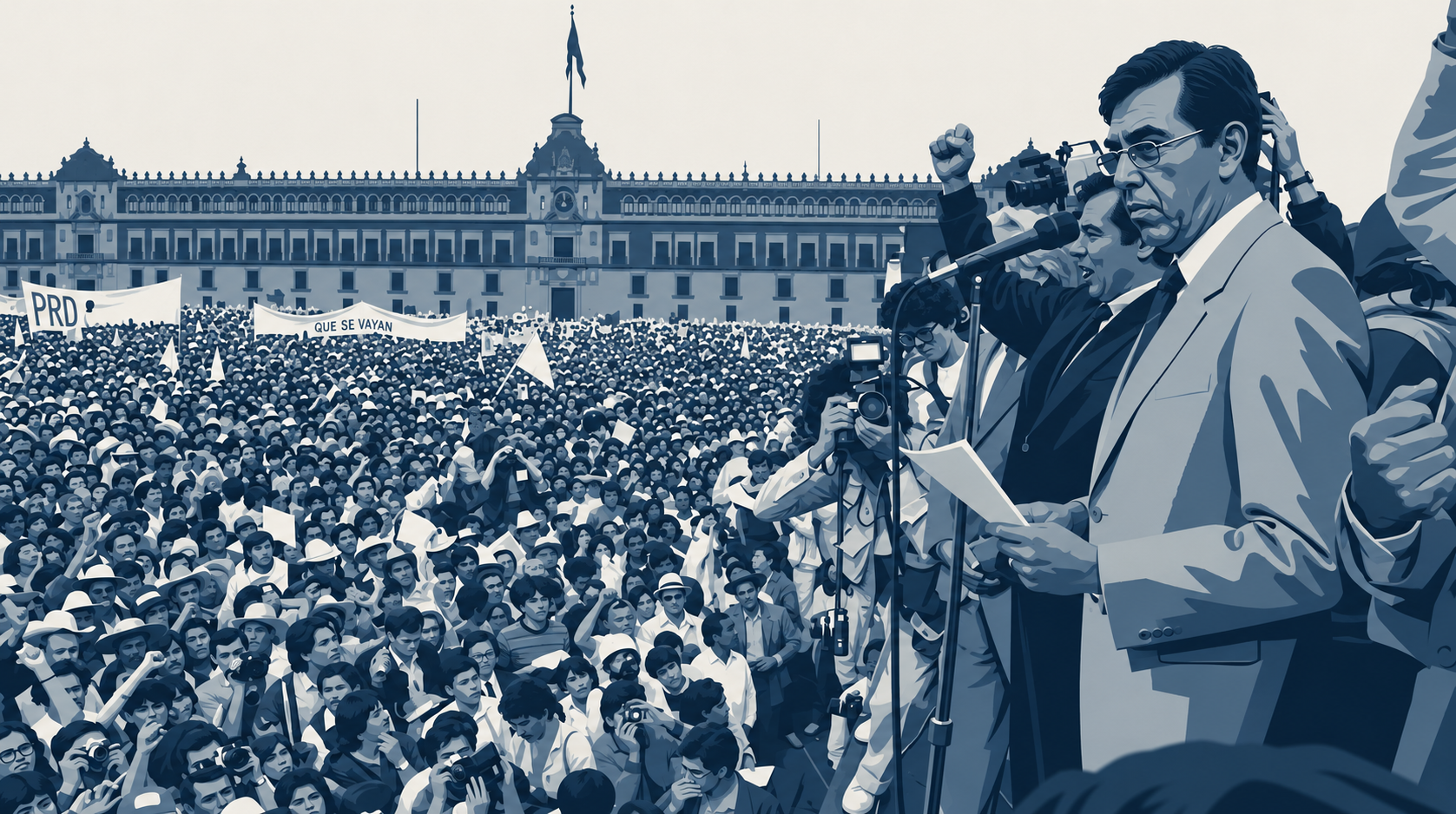
Cuauhtémoc Cárdenas died Wednesday night. His name became tied to the 1988 election and to the distrust in the vote count that led to the creation of the IFE, the predecessor of today’s INE. That same week, the institute lost its president, and its contracts for electoral printing supplies landed at the center of a dispute between the National Palace and the former councilors who once ran it.
Guadalupe Taddei’s resignation was only the first move. Twelve staff members from her office and three directors of strategic areas have already left their posts, while investigative reports point to contracts worth more than 1 billion pesos since 2014 for companies owned by the Hernández Casillas brothers in at least 13 state electoral bodies. Ricardo Monreal expects the replacement to be chosen on December 6 or 7. Sheinbaum proposed that Talleres Gráficos de México produce the electoral printing materials and asked the ASF to review contract awards going back to 1999; Lorenzo Córdova replied that his tenure was among the most audited in the country, accepted another review, and accused the president of trying to divert attention.
Morena had its own supplier file. An MCCI investigation documents that Grupo Maferefun, a contractor for the Ministry of Welfare (Bienestar), charged the party 11.4 million pesos for the registration of applicants for the state coordinator posts, after registering as a supplier with the INE five days after Ariadna Montiel took over the party leadership. Montiel, meanwhile, took her feud with Maru Campos to the courts with three complaints, after the Security Cabinet said it had no official information about the alleged meeting with “El Guano.”
In Congress, canine teams detected 35 deputies entering San Lázaro armed, even though the chamber’s rules prohibit it, following the brawl between PRI and MC lawmakers. The Senate removed a decade of budget information covering 10.2 billion pesos from its website, and Artículo 19 is already demanding sanctions. The Senate also sent the Income Tax (ISR) Law back to the deputies with an exemption for automakers and gas stations, which the Finance Committee will review on November 4 without waiving procedural steps.
And in Jalisco, the water crisis cost Pablo Lemus his Secretary General of Government, Salvador Zamora, holder of an agricultural concession for 90,000 cubic meters a year. The federal government came to the rescue with 14.5 billion pesos for water infrastructure, which, together with the state’s contribution, adds up to nearly 25 billion.
Cuauhtémoc Cárdenas, Who Paved the Way for the Mexican Left, Dies
Mexican politics has lost one of the figures who marked the break with the old PRI system and the construction of an opposition with a real chance of contending for power. Cuauhtémoc Cárdenas Solórzano died at 92, after a career whose turning point came in 1988, when he led the National Democratic Front (Frente Democrático Nacional) in a presidential election marred by allegations of fraud and the so-called “system crash.” The son of former president Lázaro Cárdenas, the civil engineer broke with the PRI, drove the founding of the PRD in 1989, and ran for president three times. His legacy is not limited to electoral defeats: he helped reorganize the left, broaden political competition, and open a different chapter in the country’s democratic history.
In 1997, Cárdenas won the first popular election for head of government of what was then the Federal District, a victory that consolidated the left’s advance in the capital and transformed the political relationship between the city and federal power. His career was also marked by differences with party leaderships and by his own positions on issues such as energy sovereignty and the direction of Mexican democracy. Even after leaving the PRD in 2014, he remained present in public debate; in March 2026 he was appointed chair of a Pemex expert commission to analyze the future of hydrocarbons. His death closes a fundamental chapter of Mexico’s political transition and leaves open the question of whether that project, which sought to democratize the system from within its own ranks, still holds.
Claudia Sheinbaum bid him farewell as “a man of firm principles” and went further, writing that in that election Cárdenas “should have been recognized as president.” For the president, that peaceful democratic movement marked the beginning of the democratic transformation, and his career honored the legacy of General Cárdenas through the defense of national sovereignty and social causes. Andrés Manuel López Obrador called him a “forerunner of the democratic movement” and summed up his weight in a single line: “Without him, the country’s political reality would be different.”
🔗 El País: Cuauhtémoc Cárdenas, historic leader of the Mexican left, dies at 92
After Taddei’s Fall, the Purge of Her Network at the INE Begins
Guadalupe Taddei’s resignation did not defuse the scandal at the INE; it opened a new phase of scrutiny of the structure of officials and suppliers that operated during her tenure. Investigative reports document that companies linked to the Hernández Casillas brothers obtained more than 1 billion pesos in contracts since 2014 in at least 13 state electoral bodies, through allegedly rigged tenders. On top of that are contracts worth more than 278 million pesos with Talleres Gráficos de México. The network’s reach also spans different administrations: between 2018 and 2025, companies tied to José Alfredo Hernández Casillas accumulated at least 49 contracts worth 1.45 billion pesos with the INE and local electoral bodies. The investigations thus point to a web that did not begin with Taddei, but that makes it necessary to clarify which officials enabled it to continue.
Taddei’s departure is already being felt in the institute’s structure. According to Milenio, 12 staff members from Taddei’s office resigned; they are joined by three directors of strategic areas who left their posts, among them the head of Material Resources and Services. Interim president Blanca Yassahara Cruz García will have to steer the review of appointments, while the Internal Control Body and audit authorities must determine whether there are administrative or criminal liabilities. The PAN has already filed a complaint with the FGR against officials, businesspeople, and private individuals for alleged crimes related to the handling of public funds.
The crisis, moreover, erupts at the worst possible moment for institutional operations: Mexico is already in the midst of the 2026-2027 electoral process, which formally began on September 10 and will culminate with election day on June 6, 2027. The INE must organize the renewal of all 500 federal deputy seats and coordinate, together with local bodies, elections in all 32 states, with more than 19,000 posts at stake. At the same time, the Chamber of Deputies will have to conduct the procedure to choose the institute’s new president: a public call, a Technical Evaluation Committee, and a vote by a two-thirds qualified majority of lawmakers present, with a lottery (insaculación) as the constitutional fallback if consensus is not reached. The succession and the investigations will move forward at the same time that the electoral machinery must keep running. That is why the transition will not be measured solely by resignations or new appointments, but by the transparency of the contracts, the independence of the investigations, and the INE’s ability to guarantee reliable elections while clarifying whatever responsibilities may be established.
🔗 Milenio: 12 officials from Taddei’s office resign voluntarily
INE Will Get a New Head in December: Monreal Eyes a Vote on the 6th or 7th
Ricardo Monreal expects the Chamber of Deputies to choose, between December 6 and 7, the person who will replace Guadalupe Taddei as head of the INE. The process includes a public call, the formation of a Technical Evaluation Committee, and a vote requiring a two-thirds qualified majority of deputies present; if that is not reached, a lottery will be used. The succession will unfold while the institute is already in the midst of the 2026-2027 electoral process, with the organization of federal and local elections underway and under pressure from the investigations into contracting during Taddei’s tenure. The challenge will be to renew the leadership without compromising electoral operations or the institute’s autonomy.
🔗 Reforma: Proposal to choose INE replacement between December 6 and 7
4T Seeks to Push Private Firms Out of the Electoral Printing Business
The controversy over electoral material contracts is escalating and opening a new front between the federal government and the INE’s suppliers. Claudia Sheinbaum proposed strengthening Talleres Gráficos de México so that the state-owned company produces the electoral printing materials, reducing dependence on a group of around four private companies that, according to the president, have concentrated contracts for more than two decades. She also asked the Federal Superior Audit Office to review the contract awards from their origins, determine responsibilities, and pursue administrative or criminal sanctions if irregularities are proven. The strategy seeks to move the discussion beyond the tenure of Guadalupe Taddei, whose departure from the institute put its contracting under scrutiny, and to trace the origin of the relationships between suppliers and electoral institutions back to 1999. The challenge will be to prove the alleged anomalies and to ensure that greater state participation translates into transparency, competition, and effective controls over the production of materials for the 2027 elections.
🔗 Reforma: CSP seeks to take the electoral printing business away from private companies
Córdova Defends His Tenure and Agrees to a New Audit of the INE
Lorenzo Córdova responded to Claudia Sheinbaum’s call to review INE contracts under previous administrations and asserted that, between 2014 and 2023, the institute was one of the most audited institutions in the country. He maintained that the observations of the Federal Superior Audit Office (ASF) were addressed and that the last review of his term, covering 2022, concluded without findings. The former president councilor said he was willing to undergo a new audit, though he accused Sheinbaum of trying to divert attention from the institute’s current crisis. The review will put both his tenure and Guadalupe Taddei’s under scrutiny, amid investigations into alleged contracting irregularities.
Federal Government Comes to Lemus’s Rescue Amid Water Crisis
The water crisis in Jalisco has escalated from citizen protests and questions about police conduct into a political problem for Pablo Lemus. The revelation that Salvador Zamora, his then Secretary General of Government and one of his closest allies, held a concession for 90,000 cubic meters of water per year for agricultural use, equivalent to filling 36 Olympic swimming pools, ended up adding pressure on an administration already under fire for supplying murky water and for shortages. Zamora left his post without publicly answering El Universal’s questions about the concession.
In that context, the federal government stepped in to shore up Lemus’s response: Claudia Sheinbaum announced a federal investment of 14.5 billion pesos for water infrastructure, to be added to the 10.2 billion planned by Jalisco, in a package of nearly 25 billion. The agreement includes infrastructure to improve water supply and quality in the Guadalajara Metropolitan Area, including new aqueducts and sanitation works, without taking on debt or privatizing the service, according to both governments. The federal support arrives as the crisis has stopped being solely an infrastructure problem and has become a source of political erosion for the governor: it remains to be seen whether the investment translates into clean, steady water for the population, and whether the explanations about the concessions and the authorities’ conduct will live up to public pressure.
🔗 Reforma: Federal government and Jalisco to inject 25 billion pesos into water projects
🔗 El Universal: Lemus’s right-hand man holds water concession equal to 36 Olympic pools; leaves post
35 Deputies Were Entering San Lázaro Armed
The Chamber of Deputies found that 35 lawmakers enter the premises carrying firearms, according to a report from the Security Directorate to the Executive Board and the Political Coordination Board. The canine teams, trained to detect weapons and explosives, flagged vehicles and deputies carrying weapons. The finding comes even though Article 25 of the Chamber’s Rules expressly prohibits armed persons from entering. After learning of the report, the Executive Board asked parliamentary coordinators to have their caucuses stop entering with weapons.
The stepped-up vehicle inspections and access controls came after the clash between PRI and Movimiento Ciudadano lawmakers. The measures include mirror inspections, canine detection, and new restrictions on the entry of advisers and support staff, as well as biometric registration for some of those accredited. The figure of 35 deputies raises a fundamental question: how carrying weapons into a venue where it is expressly prohibited became normalized, and what mechanisms will be applied to ensure the rule is enforced.
The Senate Erases a Decade of Transparency
The Senate removed from its official website the budget and administrative information for 2014-2024, eliminating from direct public access a decade-long record of the management of 10.2 billion pesos. Among the deleted documents are payrolls, contracts, tenders, purchases, travel expenses, severance payments, and funds given to the parliamentary groups, with no updated breakdown of how the money was spent. The upper chamber justified the decision by arguing that the information can be consulted on the National Transparency Platform (PNT), but a review by Excélsior found that the historical files are not available or lead to broken links.
The case escalated with Artículo 19’s accusation that the Senate is failing to meet its transparency obligations: Article 60 of the law requires including a direct link to the PNT, not deleting records from the institutional website. The organization also warned that disaggregated data for 2025 and 2026 on contracts, purchases, payrolls, and funds given to the caucuses is missing, and demanded sanctions. The controversy exposes an additional problem: complaints of non-compliance must go through the current system of oversight authorities, following the elimination of the INAI as an autonomous body. Instead of facilitating accountability, the referral to a platform that does not contain the files has turned the search for public information into an obstacle course.
🔗 Excélsior: Senate makes public information disappear; refers users to transparency platform
Maru Campos and Ariadna Montiel Take Their Clash to the Courts
The confrontation between Chihuahua governor Maru Campos and Morena national president Ariadna Montiel has moved from public accusations to a legal offensive. Montiel announced that she will file complaints for alleged moral damages, slander, and gender-based political violence, after the PAN governor linked her to organized crime. The Morena leader rejected the accusations and maintained that evidence must be presented to the authorities. The conflict also reached journalist Héctor de Mauleón and El Universal, from whom Montiel demanded a public apology for publishing a column about an alleged meeting with Aureliano Guzmán Loera, alias “El Guano,” brother of Joaquín “El Chapo” Guzmán. The federal Security Cabinet, according to reports, said it has no official information confirming that the alleged meeting took place.
The feud has a second dimension: the 2027 race for Chihuahua. Montiel announced that Morena will back the electoral complaint filed by Cruz Pérez Cuéllar against Campos, whom he accuses of intervening in the succession race by expressing support for a PAN hopeful. The Morena leader maintains that the governor is acting as a campaign manager, while the clash intersects with the political crisis over the operation against a drug lab in which CIA agents took part and the investigation into former state attorney general César Jáuregui. Accusations of alleged criminal ties are thus intertwined with the partisan dispute for political control of the state. The announced complaints will have to translate into proceedings and evidence for the authorities to determine whether any violations occurred; for now, the confrontation has already placed Chihuahua at the center of the clash between Morena and the PAN before the electoral race formally begins.
🔗 Proceso: Montiel prepares three complaints against Maru Campos
From Bienestar Supplier to Morena Contractor
Grupo Maferefun went from receiving contracts from the Ministry of Welfare (Bienestar) to becoming a Morena supplier, for 11.4 million pesos, to organize the registration of applicants for the state coordinator posts in defense of the Transformation, an internal process ahead of the 2027 elections. An investigation by Mexicans Against Corruption and Impunity (MCCI) documents that the company obtained at least 21 contracts from Bienestar worth 307.5 million pesos between 2021 and 2026, plus another eight contracts with federal agencies worth 3.1 million. The detail that puts the case under the microscope is the sequence: on May 3, Ariadna Montiel took over as Morena’s national leader, and five days later, on May 8, Maferefun registered as a supplier with the INE. In June, it organized the five-day applicant registration event at the World Trade Center, which cost 11,431,000 pesos.
The investigation also notes that during Montiel’s tenure at the head of Bienestar, between January 2022 and April 2026, the ministry awarded Maferefun another 13 contracts worth 190.5 million pesos. It also questions why the company remained classified as a microenterprise despite the volume of public funds it received, and reports that a visit to its registered business address in Mexico City’s Central de Abastos found no signs or visible references to the company. Counting the government contracts and the Morena payment, MCCI identifies at least 322 million pesos in public resources linked to the firm. The case raises questions about contracting criteria, the relationship between government and party suppliers, and the use of resources for political promotion before the formal start of pre-campaigns.
Senate Opens a Tax Exemption for Automakers and Gas Stations; Deputies Halt Fast Track
The Chamber of Deputies received the bill amending the Income Tax Law (ISR), returned by the Senate with changes that exclude certain automakers and gas stations from a mechanism to control tax deductions applicable to taxpayers with revenues above 50 million pesos. The Finance Committee will analyze the change on November 4, without waiving procedural steps, according to its chair, Carol Antonio Altamirano, who argued that regulatory deadlines should be respected. The change reopens the debate over the tax treatment of specific business sectors and must still be approved by San Lázaro to advance in the legislative process.
🔗 Proceso: Chamber of Deputies receives ISR Law bill with changes approved by the Senate
Quick Takes
I offer an apology, because this time there will be no apology, Héctor de Mauleón
In his two columns on the case, Héctor de Mauleón revisits the allegations of a supposed meeting between Ariadna Montiel and Aureliano Guzmán Loera, alias “El Guano,” brother of Joaquín “El Chapo” Guzmán, and the political implications of a story that has placed the official under scrutiny. The author questions the explanations offered in response to the accusations and raises the problem of accountability when allegations arise about possible ties between public figures and organized crime figures. The controversy also opens a front of confrontation between Montiel and those who have spread the story, with demands for clarification and threats of legal action. The heart of the matter is the need to clarify what evidence supports the accusation, what answers those involved have given, and how far public responsibility extends in the face of allegations this serious, without confusing journalistic accounts with judicially proven facts.
🔗 El Universal: I offer an apology, because this time there will be no apology
Taddei, the fruit of the assault on the INE, Luis Carlos Ugalde
For Ugalde, the resignation of Guadalupe Taddei, amid allegations of contracting irregularities, represents the culmination of a process of institutional weakening that began with Andrés Manuel López Obrador’s offensive against the electoral referee. The former president councilor argues that the greatest damage is not limited to the questions about Taddei’s administration, but lies in the INE’s loss of autonomy and impartiality. The discussion about her replacement, therefore, should not be reduced to swapping one person for another: the challenge is to restore confidence in an institution whose independence was compromised by political conflict.
🔗 Reforma: Taddei, the fruit of the assault on the INE
What not to ask for in this INE purge, Salvador Camarena
Camarena warns that the INE overhaul should not be framed as an operation to calm markets or send signals of confidence to investors. In his view, the priorities are to clarify the alleged irregularities in the contracts of Taddei’s administration and to choose a suitable profile to lead the institute. The columnist argues that the private sector is more concerned about energy availability, legal certainty, and the government’s ability to meet its obligations than about changes to the electoral referee. The purge, he contends, must respond to the need to correct the institute’s problems, not to an economic image strategy.
🔗 El Financiero: What not to ask for in this INE purge
What revived the Mexican economy?, Gerardo Esquivel
Esquivel identifies two engines behind the Mexican economy’s recent recovery: the rebound in investment and the dynamism of manufacturing exports, particularly non-automotive products linked to the technology industry and artificial intelligence. Growth in public investment and the recovery of private investment, together with rising foreign sales, have improved the economic outlook for 2026 and fostered the creation of formal jobs. However, the analysis points to a recovery that depends on specific factors and whose scope must be assessed in light of its sustainability, beyond the positive figures of recent months.
🔗 El País: What revived the Mexican economy?
The Agenda in Brief
· October 30, 31 | Active and retired IMSS workers are calling a nationwide mega-march to demand better wages and working conditions, as well as the resignation of union leader Rafael Olivos Hernández. A national founding assembly is also scheduled for Saturday the 31st to define the movement’s organization and elect representatives.
· November 3 | U.S. midterm elections. The entire House of Representatives and one-third of the Senate will be up for election. Mexico expects a signal from Washington on the USMCA after that date.
· December 6, 7 | The Chamber of Deputies plans to choose the person who will replace Guadalupe Taddei as head of the INE, according to the schedule announced by Ricardo Monreal. The date will depend on approval of the call for applicants, the evaluation of candidates by a Technical Evaluation Committee, and completion of the various stages of the process.