
Mexico Media Chatter, October, 2026
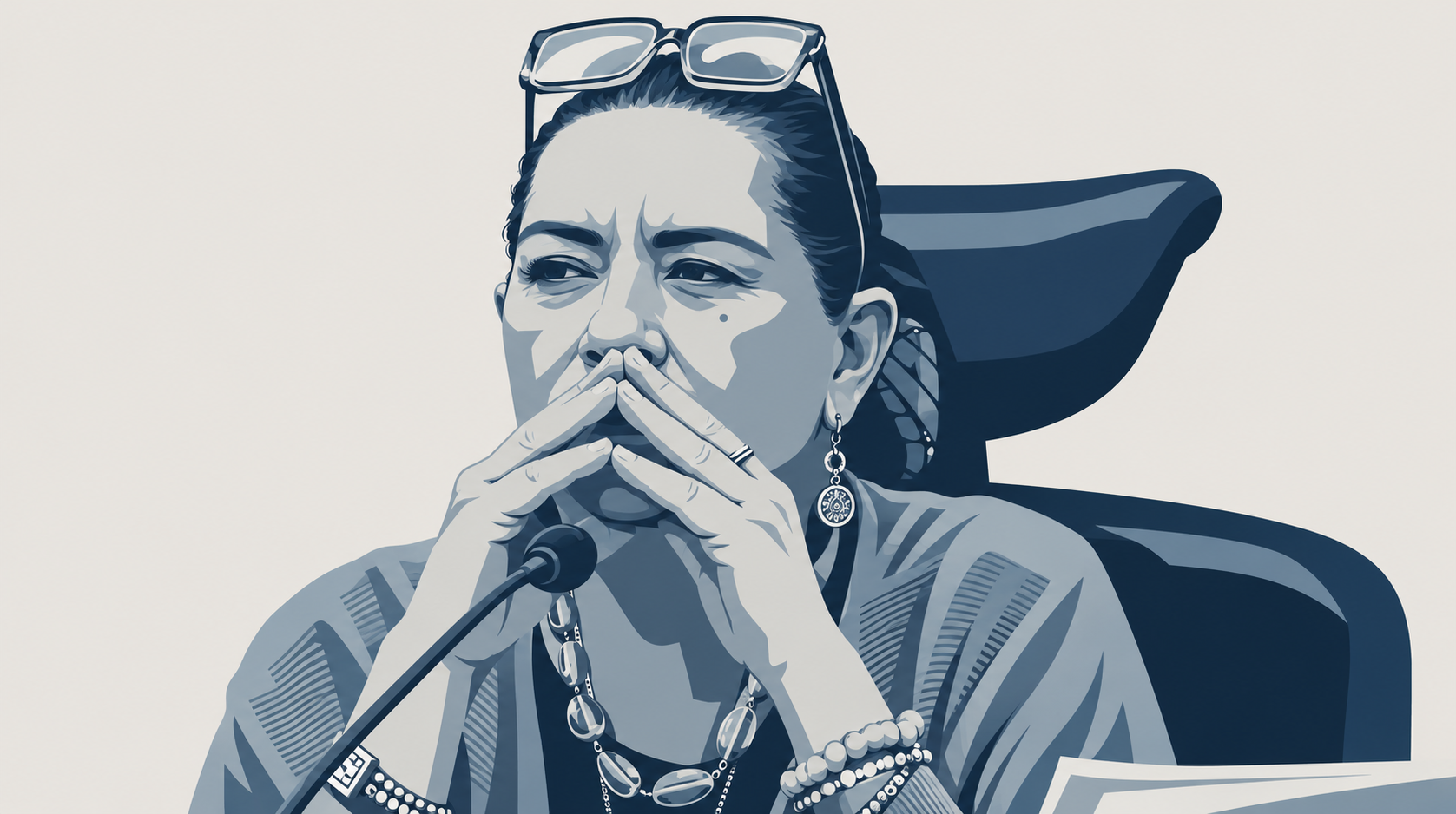
Journalism corners Taddei: a chain of investigations ends in her resignation
The departure of Guadalupe Taddei from the presidency of the INE brought to the fore the weight that investigative journalism can reach when different outlets document, expand on and keep scrutinizing the same case. The coverage was not limited to the leaks from Latinus, which released images of social gatherings and a video of the official’s son with a businessman in Paris. Reforma also followed up on multimillion-peso contracts awarded to companies linked to people close to the council president, fueling questions about possible conflicts of interest and the relationship between suppliers and officials of the electoral body. The accumulation of publications turned scattered allegations into a matter of national relevance.
The case also went beyond the media confrontation. In his October 27 column in El Financiero, Alejo Sánchez Cano credited investigative reporting with a decisive role in Taddei’s political outcome, while Politicón, from Vanguardia, asked whether her departure would have happened without the work of traditional journalism. Raymundo Riva Palacio returns to the episode in Periodistas, enemigo #1 de Palacio, where he argues that the revelations accumulated over more than two and a half years made Taddei’s continuation untenable and forced the institutions to react. The columnist also warns of a new communication strategy from the National Palace aimed at gauging the influence of critical journalists and finding ways to contain their impact.
The episode opens a fundamental discussion about the role of the media in accountability: while social networks speed up the circulation of images and allegations, investigative journalism provides documentation, context and continuity. The coverage by Reforma, Latinus and other outlets shows how different pieces of reporting can complement each other and keep an issue on the public agenda. It also exposes the tension between journalistic scrutiny and the responses of those in power to criticism. Taddei’s departure does not by itself prove all the accusations or replace the official investigations, but the case leaves a lesson about the press’s ability to raise the political cost of unanswered questions and demand explanations from those who head public institutions.
24 Horas daily gets new leadership and renews its newsroom
The 24 Horas daily began a new stage after the departure of Antonio Torrado, who led the project, and of Armando Estrop, its former general manager. At the head of the new structure are Claudia Rincón Pérez, as chair of the Board of Directors, and Jonathan Deneb Torres, as general manager. The renewal also reached the newsroom, with Hiroshi Takahashi as editorial director, Saúl Hernández as editor-in-chief and Daniel Lizárraga at the head of Investigations, in addition to other profiles that strengthen the news areas. The arrival of Takahashi and Hernández stands out for their backgrounds linked to El Sol de México, where the former was director and the latter worked as a data journalist and investigative reporter, as well as Lizárraga, who spent a short time at that outlet. The handover represents a reconfiguration of the newspaper’s management and editorial structure, which maintains its free distribution model.
The change of management also opened a debate about the daily’s editorial orientation. In journalistic circles, some of its first front pages were questioned, noted for their closeness to the pro-government agenda, although the tone has since shown nuances. The identity of the new owners, however, continues to raise questions. At first, businessman Oliver Fernández was mentioned as a possible buyer, a version that was denied; more recently, journalist Enrique Rodríguez reported that two high-level sources attributed the acquisition to Grupo Andrade, a corporation headed by Ángel Mieres Zimmermann and linked to El Heraldo de México. So far, that version must be treated as hearsay and not as a publicly confirmed transaction. The unanswered question of who is behind the purchase adds a relevant dimension to the follow-up of this transition, at a time when ownership movements and editorial decisions of Mexican media are once again under scrutiny.
The Note: The opinion section of 24 Horas brings together a group of columnists who combine political analysis and current affairs. Among the bylines are Jaime Núñez, Julio Patán, Juan Manuel de Anda, Ana María Alvarado, Dolores Colín, José Ureña and Miriam Castillo, as well as cartoonist Víctor Vélez, known as Chubasco.
Sheinbaum’s mañanera: who asks, who hogs the microphone
The promise of pluralism and accountability in presidential press conferences clashes with an unequal distribution of the floor. An analysis by Nayeli Roldán, in collaboration with Manuel Toral for W Radio, reviewed 485 mañaneras of Claudia Sheinbaum, held between October 2024 and September 2026, to identify who asks the most, how many questions they ask and how long the presidential answers are. The central finding is that the 10 people with the most turns account for one fifth of all interventions. In addition, when reviewing the editorial line of 40 participants, the investigation found that half represent outlets that express support for the government. The exercise not only portrays who manages to take the microphone, but also opens a discussion about the criteria for access, the plurality of voices and the real capacity of the conference to function as a mechanism of public scrutiny, although the investigation lacked data on reporters’ attendance, that is, how many times they were actually present.
Nancy Flores, of Contralínea, leads the record with 71 interventions and 505 questions, followed by Hans Salazar, of Noticiario en Redes, with 68 turns and 667 questions. Both have participated without interruption throughout the two years analyzed. However, having fewer turns does not necessarily mean asking fewer questions: independent journalist Reyna Ramírez has accumulated 985 questions in 14 interventions, some of them with exchanges of up to 40 minutes, while other reporters with a more limited presence have pressed on matters of public interest. The analysis also measures the length of the answers: among the participants who receive the shortest replies is Eduardo Dina, of El Universal, with 46. In a context in which the mañanera concentrates a good part of government communication, the investigation raises a fundamental question: it is not enough to open the microphone; it also matters who gets the floor, what topics they put on the agenda and what answers they get.
Top 10 journalists with the most interventions:
- Nancy Flores, Revista Contralínea: 71 interventions | 505 questions.
- Hans Salazar, Noticiero en Redes: 68 interventions | 667 questions.
- Yaneth Arciniega, Revista Fortuna: 65 interventions | 515 questions.
- Juan Hernández, Diario Basta: 61 interventions | 500 questions.
- Carlos Navarro, Heraldo Media Group: 60 interventions | 512 questions.
- Carlos Guzmán, Quatro Media Telecomunicaciones: 55 interventions | 515 questions.
- Arturo Pavón, El Chapucero: 55 interventions | 342 questions.
- Shaila Rosagel, Grupo Healy: 47 interventions | 286 questions.
- Yusbel Carolina, Código Libre: 45 interventions | 365 questions.
- Demian Duarte, Sonora Power: 40 interventions | 348 questions.
Pedro Haces launches Al Aire News
Morena deputy and CATEM leader Pedro Haces launched Al Aire News, the evolution of his initial project Haces TV, with programming that includes newscasts, political debate, finance, sports, entertainment and a space specialized in bullfighting, the politician’s great passion. The outlet is under the direction of Eduardo del Río and Eduardo Arvizu, with Óscar Casanova heading the project. Its YouTube debut drew attention for its low live audience: according to Latinus, the first broadcast registered barely 61 simultaneously connected users; 314 views were subsequently reported at the close of the broadcast.
According to information circulated in various media, these are some of the profiles that would be part of the programming, according to hearsay:
- Carlos González
- Alma Saint Martin
- Alejandro Cacho
- Elizabeth Cano
- Daniela Caballero.
- Claudia Cervantes.
- Paulina Greenham.
- Ari Beteta.
- Ximena Vázquez.
The Note: Pedro Haces Barba is a politician, businessman and union leader, founder and general secretary of the Confederación Autónoma de Trabajadores y Empleados de México (CATEM), a labor organization close to Morena, and currently a federal deputy elected by proportional representation.
From investigative journalism to streaming: the stories of El Mayo and El Chapo reach the platforms
Investigative reporting on organized crime is finding a new window on streaming platforms, which turn court files, exclusive testimonies and archival material into documentary series. One example is La caída de El Mayo, a Muck Media production for Netflix, directed by Darren Foster and Mexican documentarian Miguel Fernández Flores. The three-episode series reconstructs the trajectory of Ismael “El Mayo” Zambada and the circumstances of his capture in July 2024, drawing on hundreds of court documents from Mexico and the United States, and interviews with agents, journalists, people close to the Sinaloa Cartel and the kingpin’s lawyer. The production seeks to clarify the family relationships, the betrayal and the questions surrounding his surrender to U.S. authorities; its premiere was October 29.
The bet also extends to Operación Cisne Negro, an investigation by N+ Docs that arrived on ViX on October 27 to reconstruct the escape of Joaquín “El Chapo” Guzmán from the Altiplano prison in 2015 and the operation that culminated in his recapture in Los Mochis, Sinaloa, in January 2016. Directed by Héctor Laso, produced by Denise Maerker and with Samuel Adam leading the investigation, the series consists of two one-hour episodes and brings together unpublished testimonies, intelligence information and more than 40 minutes of never-before-released footage. The team reviewed thousands of pages of court files and interviewed participants in the operation, including former president Enrique Peña Nieto and former security officials. Both projects show how investigative journalism extends its reach beyond reports and traditional media to explore long-form audiovisual narratives, with documents and voices that allow a review of episodes that marked Mexico’s recent history.
The Note: Since Denise Maerker joined to lead N+ Focus and N+ Docs in January 2023, the company’s commitment to investigative journalism and documentaries has gained visibility: on N+’s first anniversary, the company reported more than 30 in-depth investigations and five documentaries produced.
El Universal reaches 110 years
El Universal commemorated its 110th anniversary on October 1, after more than a century of documenting the country’s political decisions, conflicts and social transformations since its founding in 1916. The date vindicates the daily’s trajectory as a benchmark of the national press and the journalistic responsibility to investigate, cross-check and publish information, even when it is uncomfortable. The celebration also recognizes the generations of journalists, workers and readers who have accompanied its history, as well as Juan Francisco Ealy Ortiz, executive chairman and chairman of the Board of Directors of the newspaper. The daily is currently directed by journalist David Aponte.
The Note: El Universal is the oldest national outlet, very closely followed by Excélsior with 109 years of existence. Meanwhile, at the regional level, El Informador of Jalisco also has 109 years of existence.
Milenio Televisión turns 18
Milenio Televisión celebrated 18 years on the air since its launch on October 20, 2008, with a trajectory marked by coverage of political junctures, security events and natural disasters of high national and international impact. The channel, driven by Grupo Multimedios, bet from the beginning on 24-hour continuous news, dynamic newscasts and real-time broadcasts, a model that it later expanded to broadcast television, YouTube, social networks and mobile applications. Almost two decades after its birth, the signal seeks to maintain its presence in the news ecosystem with a strategy that combines television and digital distribution, in an environment where audiences consume news across multiple platforms.
The Note: Milenio Televisión began broadcasting on October 20, 2008, at 7:45 p.m., with a bet that was innovative at the time: offering news 24 hours a day, both on pay TV and online.
Getty Images files for bankruptcy
The financial crisis at Getty Images, one of the world’s largest repositories of photography and video, opens a debate about the future of visual archives and the business model that sustains the photography industry. The company began Chapter 11 bankruptcy proceedings in the United States, as part of a restructuring that seeks to reduce its debt and keep its operations going. The procedure does not imply the closure of the platform: Getty said it will continue to operate normally while the financial plan moves forward.
The company recorded quarterly revenue of $229.1 million, but also a net loss of $85.8 million and total debt of $2.1 billion. The plan includes up to $533 million in new investments from the Getty family and Koch Equity Development, in addition to a debt reduction; the company expects to emerge from the process as a private company. The case highlights the economic vulnerability of the large visual archives in the midst of digital transformation, although the bankruptcy does not mean that its collection will disappear.
The Note: Getty Images reported 625 million images and 39 million videos in its collection at the end of June 2026, in addition to working with more than 600,000 content creators.
Grupo Animal expands with editions in Baja California and Quintana Roo
Grupo Animal expanded its regional presence with the launch of Animal Político Baja California and Animal Político Quintana Roo, available since September 1. The initiative seeks to strengthen local journalism in two territories that are strategic for their migratory, tourism, commercial and security dynamics, with its own coverage of government, justice, the environment and accountability. Both newsrooms will operate under the editorial standards of Animal Político, with the technological and verification backing of the group, which also includes El Sabueso, Animal MX and Animal Gourmet. The expansion is part of its strategy to diversify audiences and consolidate a national presence with investigations and news agendas focused on the needs of each community. In addition, Jorge Ávila, editorial deputy director, said the expansion will continue to other states: the next locations will be Tlaxcala, Querétaro and Puebla, as part of the strategy to broaden the outlet’s national presence and develop news agendas focused on the needs of each community.
The Note: Animal Político was born in November 2010 as an exclusively digital news outlet, founded by journalist and media entrepreneur Daniel Eilemberg, together with a group of investors with editorial experience.
Manuel Arroyo, on the verge of arrest in the U.S. over the conflict with Fox
The conflict between Fox Corporation and Grupo Lauman escalated to a new judicial dimension. A federal judge in New York ordered the civil arrest of Manuel Arroyo, owner of the group that operates Fox Sports México and El Financiero, if he enters U.S. territory, due to noncompliance with court rulings related to the dispute over the use of the brand and the operation of the sports channel. The ruling points to more than 100 transfers totaling more than $12 million made despite the asset freeze, while the penalties accumulated for contempt would exceed $70 million, according to reports on the case. The litigation puts pressure on Grupo Lauman, amid a crisis that goes beyond the corporate sphere and threatens to deepen uncertainty about the future of Fox Sports México.
Informative radio has a woman’s voice: two journalists lead the audience
For the first time, two women hold the top audience spots in spoken-word radio in Mexico City: Azucena Uresti, of Radio Fórmula, and Carmen Aristegui, of Radio Centro. According to INRA measurements for September 2026, the progress is also reflected in the top 10 most-listened-to newscasts, where four programs are headed by women: in addition to Uresti and Aristegui, Gabriela Warkentin, of W Radio, and Ana Francisca Vega, of MVS Noticias, appear. Together, these four journalists account for 46% of the audience of the ten leading programs. The figure marks a change in the distribution of the radio audience and in the presence of women at the head of the main news programs.
Mario González leaves the first edition of Enfoque Noticias
Mario González announced his departure from the first edition of Enfoque Noticias, the program he hosted for nine years and left on October 30. The journalist clarified that his departure is due to a decision by the company and thanked the team of collaborators with whom he shared this stage, as well as the audience that accompanied him in the mornings. González said he will continue to inform, share his opinions and keep a critical eye on Mexican current affairs. His departure marks the close of a cycle of almost a decade at the head of one of the news programs of national radio.
Paxman reconstructs AMLO’s contradictions in a biography
The historian and journalist Andrew Paxman published Andrés Manuel. Una biografía en 50 episodios, published by Debate, an imprint of Penguin Random House, a 494-page investigation that traces López Obrador’s life from his youth in Tabasco to his arrival in the Presidency and the consolidation of Morena. The book examines the paradoxes of lopezobradorismo: the defense of the poorest sectors without a tax reform, the criticism of economic elites alongside agreements with businessmen, and the promise of justice for victims alongside the strengthening of the Armed Forces. Salvador Camarena’s column in El Financiero recovers one of the central themes of the work: austerity as a political principle and a commitment against privileges. Through episodes from López Obrador’s personal life and his first government proposals, Paxman traces how that discourse became one of the main banners of his political project and offers elements to contrast it with the practices of his circle today. More than a hagiography or a condemnation, the work seeks to explain the figure on the basis of his decisions, alliances and contradictions.
Significant departures at Capital Digital
Capital Digital faces significant movements in its editorial structure with the departures of Pablo León Arce and Cristina Salmerón. León Arce left the vice presidency of Content after two years at the head of the strategy for brands such as Chilango, Pictoline and Travesías, while Salmerón concluded a three-and-a-half-year stage as editorial director of Chilango, a position she left after the magazine’s September edition. Both highlighted the work of their teams and the results achieved during their tenure. The departures represent changes in two positions linked to content strategy and editorial development at one of the main media and lifestyle platforms in Mexico City.
Garfias leaves a legacy of four decades in Mexican political journalism
The death of Francisco Garfias, at age 75, prompted a wave of condolences among journalists, politicians and colleagues who recognized his career as a reporter, columnist and parliamentary chronicler. Author of the column Arsenal in Excélsior and founder of the portal El Arsenal, he devoted a good part of his career to closely following the movements of the Legislative branch, party negotiations and the main events of national politics. His time at outlets such as Unomásuno, Milenio and La Crónica de Hoy, as well as his stint as a correspondent in France, were part of a career of more than four decades. After his death became known, figures such as Ricardo Monreal, Alejandro Moreno, José Antonio Meade and Sergio Sarmiento publicly expressed their sorrow and remembered both his craft and his friendship and sense of humor. Parliamentary journalist Leticia Robles highlighted a characteristic that defined his work: Garfias did not wait for information behind a desk, but went in person to seek it out among his sources in Congress. In his memory, the Chamber of Deputies announced that its conference forum would bear his name, a recognition of his bond with legislative coverage and a life dedicated to documenting Mexican politics.
Luis Cárdenas arrives at Hechos AM amid criticism
Luis Cárdenas joined Hechos AM, the TV Azteca newscast hosted by Manuel López San Martín, where he participates as a commentator and analyst. His arrival came two months after ending his 16-year stint at MVS Noticias and following the public invitation that Ricardo Salinas Pliego extended to him to work at the network. The move drew criticism on social media, where users dug up a video in which Cárdenas called the businessman, now his new employer, a “jerk” (“patán”).
León Krauze takes over as deputy director of Letras Libres
After 25 years linked to Letras Libres, León Krauze took over as deputy director of the magazine starting with its October 2026 edition. A journalist and writer, columnist for The Washington Post and El Universal, Krauze took part from the beginning of the project and led the launch of Letras Libres Interactivas, which boosted the publication’s digital presence. In his new role he will collaborate on the print edition as well as the site and the digital offering, including the interview space Ciberdiálogos. Upon announcing his appointment, he thanked Enrique Krauze and the editorial team for their trust, and set free thought, criticism and journalism as the axes of this stage.
IBERO 90.9 renews its management and content coordination
IBERO 90.9 announced Sofía Garfias as the new director of the university station, in a move that points to a new stage for its radio project. Joining this change would be Álvaro Céspedes, who would take over the Content coordination, according to the information shared. Céspedes has experience in narrative journalism, sound production and podcast development, in addition to his work on Delirios Crónicos, a project linked to the station. The reconfiguration sets out a new distribution of responsibilities in the management and editorial development of Radio Ibero.
W Deportes cuts staff and reconfigures its operation
W Deportes laid off 13 collaborators, including editors, hosts and producers, as part of a restructuring that includes the closure of its newsroom and offices at Tlalpan 3000. According to reports published on October 1 and 2, Claro Sports will take over the contents of 730 AM, which will be produced from facilities of Grupo Carso.
Lilly Téllez debuts a digital newscast
PAN senator and journalist Lilly Téllez launched Voz Valiente con Lilly Téllez, a digital newscast that will be published every Sunday night on YouTube and other platforms. The controversial legislator presented the project as an alternative to what she considers restrictions and interruptions of her interventions in the Senate, with the promise of having a space of her own to set out her positions without time limits. In her first broadcast, of approximately 16 minutes, she questioned Morena and the federal government, and addressed topics such as the shortage of medicines, alleged irregularities in public contracts and the 2027 Revenue Law. With this launch, Téllez moves part of her political confrontation from the legislative chamber to a communication channel of her own in digital media, recalling that a few years ago she was a news anchor at TV Azteca, the network owned by Salinas Pliego.
Who’s who in podcasts?
| Spotify | Apple Podcast | Amazon Music |
| La Estrategia del Día | Bloomberg Línea, Jimena Tolama | Expansión Daily | Grupo Expansión | El Noti | Maca Carriedo y Javier Garza |
| Hablemos con Denise Maerker | N+ | La Estrategia del Día | Bloomberg Línea, Jimena Tolama | Expansión Daily | Grupo Expansión |
| El Noti | Maca Carriedo y Javier Garza | Noticias de la Mañana | Telemundo | La Estrategia del Día | Bloomberg Línea, Jimena Tolama |
| Política Déjà Vu | N+ | El Noti | Maca Carriedo y Javier Garza | Noticias de la Mañana | Telemundo |
Coordinates
- Teresa de Miguel Escribano announced her appointment as news director for Mexico and Central America of The Associated Press (AP). The journalist will lead the agency’s news teams in a region she described as complex and fascinating, and expressed her enthusiasm for working with the organization’s journalists.
- Valentine Hilaire joins as Global Business Reporter at Bloomberg News in Mexico City, where Hilaire will cover companies, telecommunications, retail and the auto industry, in addition to the intersection of business, politics, security and the economy.
- Analyst Gabriel Guerra announced the end of his collaboration with ADN Noticias, noting that his departure was by mutual agreement and on good terms. He will now have a space on A las Tres con Noelia Jiménez on Nmás Foro.
- Roberto Jiménez stepped down as editor of the Cartera section of El Universal. In his place, Tláloc Puga took over this area, focused on economic and financial news.
- Rodrigo Riquelme became the new editor of Technology at El Economista, where he will lead coverage of innovation, digital transformation and technology trends.