Mexico Culture Chatter, November 7, 2026
Has Day of the Dead’s Popularity Diluted Its Meaning?
New York City Mayor Zohran Mamdani set up a Day of the Dead ofrenda at City Hall this year, complete with cempasúchil, papel picado, copal, candles and photographs honouring, among others, the trans rights activists Sylvia Rivera and Lorena Borjas. In Times Square, meanwhile, The Grand Ofrenda returned with towering catrinas and an altar to departed music icons, from Pedro Infante and Juan Gabriel to Chavela Vargas and Jenni Rivera.

Scenes like these are now familiar far beyond Mexico: over the last decade or so, Day of the Dead has been widely and enthusiastically adopted abroad. At home, Halloween has kept gaining ground, merging the two holidays into “Hallow-muertos”: days of costumes, sweets, parties and parades (with perhaps a few religious pauses), a warm-up for the “Guadalupe-Reyes” marathon that begins on 12 December and ends on January 6th.
Last week El País charted the festival’s “metamorphosis” in the capital, where it now stretches across an entire month, with some 5,000 activities generating up to 12 billion pesos. Pop culture has played a significant role. Mexico City’s Gran Desfile was created after the 2015 James Bond film Spectre staged a fictional one, and Disney’s Coco still draws tourists, some of whom now pay up to 10,000 pesos for a Day of the Dead weekend package. “It is for the tourists, not for devotion,” UNAM anthropologist María Angélica Galicia Gordillo told the newspaper, adding that the profits rarely reach local communities.
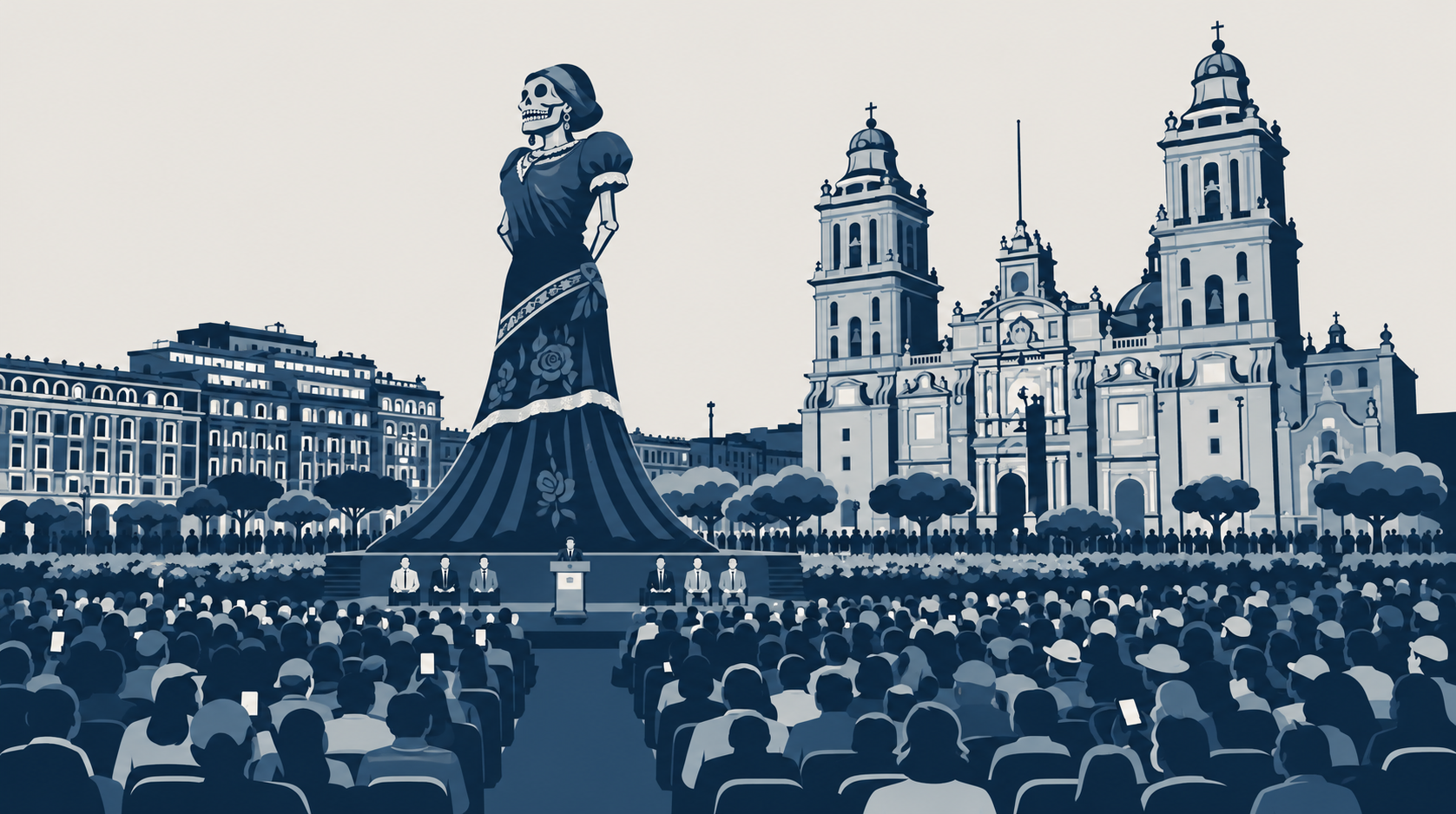
This year, Mexico City also earned a Guinness World Record for the tallest catrina: a papier-mâché figure more than 33 metres high, presiding over the monumental ofrenda in the Zócalo. The altar paid homage to José Guadalupe Posada, the engraver whose skeletal caricatures of the Porfirian bourgeoisie, above all the Calavera Garbancera, mocked the pretensions of the privileged. Mayor Clara Brugada emphasised that the catrina is a critique of vanity, classism and false appearances, and a reminder that death recognises no titles, surnames or fortunes. If Posada were alive today, he would find no shortage of those same vices in how the celebrations have been transformed by gentrification and globalisation. Resplendently dressed, elaborately made-up catrinas promenade the streets, in all likelihood blissfully unaware of the irony.
And yet, what qualifies as genuinely traditional is an open question. Veka Duncan, whose new history of the festival, Entre flores nos reciben y entre ellas nos despiden (Larousse), was published this year, argues that much of what Mexicans consider tradition is a more recent invention than they would like to think. In her account, the state has moulded the festival over centuries: from nineteenth-century civil cemeteries, through the revolutionary nationalism that recast it as Indigenous and secular, to the tourism programmes of more recent decades.
Change does not always mean loss. Even Galicia Gordillo, the anthropologist quoted above, credits the catrina craze that followed Spectre with persuading children to trade witch and monster costumes for skull make-up. She also insists that a tradition that never changes is a dead one. Beneath the face paint and the selfies lies the oldest impulse of all: to remember those we have lost and to meditate, even momentarily, on mortality. As Posada is credited with observing, death is democratic.
Fake Priests and Digital Pulpits: Mexico’s Church Confronts a Vocations Crisis
For a few hours this week, Mexican media reported that Pope Leo would visit the Basilica of Guadalupe during his first Latin American tour, which began yesterday and takes him to Uruguay, Argentina and Peru. The reports, which followed a Vatican briefing, proved premature. Vatican spokesman Matteo Bruni clarified that no visit to Mexico had been confirmed; the Guadalupe on the itinerary is a parish in Montevideo’s Casavalle district. The Vatican’s Secretary of State has said a Mexican visit will come, though no date is set. Mexico’s bishops have already invited the pope for 2031, the 500th anniversary of the Virgin of Guadalupe’s appearance.
Mexico is home to the world’s second-largest Catholic population after Brazil, but the papal visit comes as the region faces the challenges of a shrinking Church in the age of social media. Reuters published two recent reports on these trends, including the growing trade in fake priests, and how a new generation of clergy is taking to TikTok.
According to INEGI census data, Catholics fell from 89.6 per cent of Mexicans aged five and over in 1990 to 76.4 per cent in 2020. A 2024 Pew Research Center survey put the share of Catholic adults at 67 per cent, down from 81 per cent a decade earlier, and just 59 per cent among 18 to 34-year-olds. Yet about nine in ten adults in the region still profess belief in God.
The clergy is shrinking faster. Vatican figures put Mexico’s priests at 17,331, one for nearly 7,000 Catholics, more than three times the European ratio. In March, Ricardo Veloz Cuéllar of the Mexican bishops’ clergy commission told Publimetro that seminary enrolment had roughly halved in two decades, even in traditional bastions. Guadalajara’s seminary, for example, has fallen from about 700 students in the 1990s to around 350. Convents are closing too, in states including Chihuahua, Durango, Chiapas and Oaxaca.

Impostors have exploited the shortage. Officials in nine archdioceses told Reuters of growing numbers of unauthorised clergy officiating at funerals, baptisms and weddings. The problem spread during the pandemic, as families scrambled for priests. María Magdalena de Ibarrola, chancellor of the Archdiocese of Mexico, estimates that hundreds operate nationwide, from suspended or excommunicated clergy and seminary dropouts to people with little or no religious training. In one case, a self-styled priest in a cardinal’s cap granted general absolution to dozens of mourners at a Mexico City funeral. In another, a First Communion certificate near Toluca bore the signature of a priest who had died in 2020. Because the Church does not recognise sacraments administered by impostors, families may have to repeat them.
Researchers and church officials blame both the shortage and a widening gap between cultural Catholicism and the institution, with many younger Catholics treating sacraments mainly as family traditions. Social media has become the marketplace: Reuters found Facebook Marketplace advertisements for “express religious services” and certificates selling for US$30 to US$100.
The same platforms are where the Church is fighting back. A Reuters report published on 5 November describes priests, nuns and deacons across Latin America using social media to reach younger generations. Among the most followed is Heriberto García, a Jalisco priest and filmmaker who began with videos of charrería before turning to reflections for young people struggling with mental health. With more than 2.7 million followers, he sees online preaching as a bridge for people with no priest nearby, and his aim is to bring them back to religion off screen. A Vatican committee formed after the 2024 Synod of Bishops supports digital creators across the region, though some church leaders remain wary of the lack of control.
Leo has been more cautious about digital evangelisation than Francis was. In Mexico the irony is plain. Veloz blames social media and artificial intelligence for distracting the young from the spiritual, yet the screen is now both the shop window for counterfeit clergy and the pulpit for some of the Church’s most popular preachers. For a Church short of priests, telling the two apart has become part of the job.
Humberto Musacchio, Culture Chronicler, Dies at 83
Humberto Musacchio, one of Mexico’s most respected cultural journalists, died on 4 November at the age of 83. His death came a week after the jury of the Premio Nacional de Periodismo had voted unanimously, without his knowledge, to give him its award for lifetime achievement. The prize’s Citizens’ Council has since brought the announcement forward, saying it regretted not having had time to tell him or to organise a tribute.

Born in Ciudad Obregón, Sonora, in 1943, Musacchio studied economics at UNAM but did not finish his degree. He survived the Tlatelolco massacre of 2 October 1968, and much of his work went on to document Mexico’s political and social life. He began writing professionally in 1969 with book reviews for El Día. He rose to become managing editor of Unomásuno and a founding deputy director of La Jornada, and he edited the magazines Kiosco and Mira and the cultural supplement Comala. He also wrote for El Universal, Excélsior and El Financiero, covered national politics for Siempre! and hosted a cultural programme on Radio Red. For decades, his weekly column La República de las Letras served as a running chronicle of Mexico’s cultural life.
Alongside his journalism, Musacchio produced reference works of remarkable scope. His four-volume Diccionario enciclopédico de México (1989), compiled largely single-handed, was followed by similar dictionaries of Mexico City, Guanajuato and Nayarit. ¿Quién es quién en la política mexicana? became a standard reference. His histories of the Mexican press, including Historia gráfica del periodismo mexicano and Historia crítica del periodismo mexicano, led the prize jury to call him “the memory of this profession”. He also published collections of chronicles, among them Ciudad quebrada (1985) and Urbe fugitiva (2002), and taught at the Escuela Carlos Septién García, CIDE and UNAM.
News of his death prompted an outpouring of tributes. The Ministry of Culture praised a career of more than five decades devoted to preserving the country’s cultural and intellectual memory, and to defending freedom of expression and journalistic independence. The Fondo de Cultura Económica mourned the loss of one of its authors. The academic Sergio Aguayo remembered a man committed to democracy and human rights, as well as a loyal friend. Journalist Ricardo Raphael wrote that he would miss Musacchio’s “hoarse voice and weighty thought”.
In March, Musacchio was honoured for his cultural journalism at the Coyoacán International Book Fair. He is survived by his wife, Duska, and his children, Marusia and Aldo. The Premio Nacional de Periodismo will announce details of its posthumous tribute alongside the winners of its 2025 edition on 10 November.
Mexican Spanish Makes a Dent in the Dictionary
Mexican Spanish is well represented in the 24th edition of the Diccionario de la lengua española (DLE), produced jointly by the Real Academia Española (RAE) and the other Spanish-language academies through their association, ASALE, and presented in Madrid. New entries marked as Mexican usage include acitronar (to sauté onion and garlic until translucent), chambitas (someone who takes on any informal odd job), checador (a timekeeper, or a clocking-in machine), credencializar (to issue or obtain an ID card), fregonería (something impressive), imeca (the unit measuring air pollution in Mexico City’s metropolitan area), troquero (a lorry driver) and mataleón (a rear chokehold). Fotomulta, a traffic fine issued by camera, is recognised as shared by Mexico, Argentina, Colombia and Ecuador.
According to El País, the edition includes more than 6,000 new entries in all, counting both new words and new meanings. Technology dominates: IA (artificial intelligence), ciberseguridad, renderizar, resetear, código QR and even cúbit (qubit) all make the cut, as does the vocabulary of digital media: influencer, pódcast and post. Words relating to identity and discrimination also enter, among them trans, gordofobia (fatphobia), racializar and edadista (ageist), alongside environmental terms such as ecoansiedad, turistificación and basuraleza, a blend of basura (rubbish) and naturaleza describing litter left in nature. Colloquialisms such as porfa (please) and cumple (birthday) are now official too.
The edition also changes how the dictionary works. For the first time, meanings within each entry are ordered by frequency of use rather than grammatical category, and words with gendered forms now show the feminine in full (“técnico, técnica” rather than “técnico, ca”). It is also the first edition built from the digital version rather than the printed one. In total it contains 99,990 entries and more than 209,000 senses, over 20,000 of them marked as specific to the Americas, according to La Jornada.
RAE director Santiago Muñoz Machado noted that the launch coincides with the 300th anniversary of the first volume of the Diccionario de autoridades, published in 1726 and regarded as the founding work of the academy’s lexicography.
Chatter Box

Bones beneath Buenavista
INAH has announced the discovery of a probable ossuary on the route of the Mexico City-Querétaro passenger train, near the Buenavista terminal in Mexico City. The first human remains were found on 17 September during track-bed works. Below 1.4 metres, archaeologists found a secondary burial deposit, with the bones gathered without anatomical order.
So far the team has recorded the remains of nine individuals, two with cranial modification, along with five jawbones and well-preserved long bones. Found alongside them were domestic Aztec III pottery, including salt-making vessels from the former Lake Texcoco, miniature spindle whorls, figurines and green obsidian blades probably from Hidalgo’s Sierra de las Navajas.
The deposit may date from the Late Postclassic (1200-1519) or the early contact period, although INAH researchers say the material could extend into colonial times. The site lay within Nonoalco, one of Tlatelolco’s 19 pre-Hispanic neighbourhoods, near the sixteenth-century church of San Miguel Nonoalco. Physical anthropologist Abril Machain Castillo notes that only durable bones were found, which suggests the dead were moved here from an earlier burial ground. The finds are now in project laboratories in Hidalgo, where analysis will determine the individuals’ age and sex.
Change here for books: the Metro opens a reading club
Mexico City’s Metro is inviting passengers to trade delays for books. Since 5 November, the system has been hosting Transbordo literario (roughly, “Literary Transfer”), its first reading club, at the Museo del Metro near Mixcoac station on Line 12. Free sessions run every Thursday from 11am to 1pm and from 4pm to 6pm, with no end date announced. Margot Cortázar, the Metro’s institutional voice, pointed to what the Metro and books have in common: both take you somewhere else. The launch follows weeks of serious disruption for commuters, with services hit by fires and explosions on platforms, according to El País. It also rides a global reading wave, with “BookTok” flourishing, and Dua Lipa and other celebrities launching book clubs almost as frequently as podcasts. Mexico shares the appetite: INEGI’s 2025 Reading Module found that 79 per cent of literate Mexicans read some kind of material, with books the most popular format (62.5 per cent) and more than 81 per cent preferring print to digital.
Borges in the Labyrinth
Forty years after the death of Jorge Luis Borges, Mexico City is inviting readers to lose themselves in his work, quite literally. Laberinto Borges, a walk-through installation of forking paths and mirrors created by Penguin Random House México and the Argentine Embassy, opens at the Museo de la Ciudad de México on 7 November. Each visitor receives a free copy of El jardín de senderos que se bifurcan, the story most closely tied to the author’s fascination with labyrinths.
Alongside it runs ¿Nos volveremos a ver?, 30 mostly unpublished photographs by Rogelio Cuéllar from Borges’s first visit to Mexico in 1973. Cuéllar followed the writer for almost a week, earning the nickname “duende” (imp). The title comes from their farewell: when Cuéllar asked if they would meet again, Borges replied that they would see. The anniversary has also led Alfaguara to reissue Borges’s complete works across Spain and Latin America, with Poesía completa, Ficciones and a volume of previously unpublished lectures due this month.
Laberinto Borges is open on 8, 14 and 15 November. Museum entry costs 46 pesos and is free on Sundays.
A new biennial opens in Yucatán
Mérida will host the first Bienal de Yucatán from 26 November to 28 February 2027, with 76 artists from 20 countries across 16 venues in the city’s historic centre and Maní. Entry is free throughout.
Founded by Catherine Petitgas and directed by curator Daniela Pérez, the biennial takes language as its starting point. Artistic director Abraham Cruzvillegas’s central exhibition, Vocal, is housed in the sixteenth-century former convent of the Casa de la Cultura del Mayab. It explores speech, writing, translation and silence, emphasising Maya as a living language with a future rather than a relic. Roughly half the participants are Mexican, more than half of those from Yucatán. Maya-speaking artists from the peninsula and Guatemala will show alongside Yoko Ono, Teresa Margolles and Óscar Murillo. Three companion exhibitions include a Museo Jumex group show and a survey of Mathias Goeritz’s legacy in concrete poetry. In Maní, the programme extends to the former convent where Maya codices were burned in 1562. Further editions, on identity and gender and on ecosystems and water, are planned for 2028 and 2030.
Puebla to host UNESCO Learning Cities Conference
Puebla has been chosen to host the seventh International Conference on Learning Cities (ICLC 7), UNESCO’s triennial gathering of mayors, policymakers and practitioners committed to lifelong learning. The conference is due to take place in June 2027, making Puebla the second Mexican city to host it, after Mexico City in 2015.
This edition will focus on learning cities in the age of artificial intelligence. It will examine how digital innovation can widen access to education while reducing inequality and strengthening social cohesion. Discussions are expected to cover digital inclusion, future skills and the governance of emerging technologies.
Organised by UNESCO’s Global Network of Learning Cities, the series began in Beijing in 2013 and has since addressed inclusion, health, sustainability and climate action. Puebla joined the network in 2020. Mayor José Chedraui Budib called the appointment a source of immense pride and a chance to showcase a city with almost five centuries of history. Local officials expect the event to give tourism a significant boost.
Learning from mistakes at the Franz Mayer
Designer Jorge Diego Etienne celebrates trial and error in Mockups Before Fuckups, now at Mexico City’s Museo Franz Mayer, where it inaugurates the museum’s new design and process gallery. Expanded since its 2025 Monterrey debut, the show gathers more than 300 objects, from sketches to 3D-printed models, drawn from over 100 projects spanning almost 15 years of his studio, JDE design. Work for brands such as TANE, Tupperware and Cemex sits alongside tableware for Michelin-starred Pangea, bus stops in San Pedro Garza García and public parks in León. There is also an aluminium pencil holder Etienne designed as a student. Organised around the studio’s five-stage method and 15 guiding principles, the exhibition frames errors as learning tools; workshops, guided tours and talks accompany it. The exhibition runs until 14 February 2027, Tuesday to Sunday from 10:00 to 17:00. Entry costs 130 pesos (75 pesos for students, teachers and INAPAM cardholders).
Carlos Amorales, between crayons and AI
In Anteparaíso, at Mexico City’s Kurimanzutto gallery, Carlos Amorales uses children’s wax crayons and artificial intelligence to explore technological colonialism. Borrowing its title from Raúl Zurita’s 1982 poetry collection, the show brings together around 200 drawings.
The main installation reworks H. G. Wells’s The War of the Worlds, in which imperial Britain is itself invaded by technologically superior Martians. Amorales imagines farming creatures, part human and part plant, subjugated by aliens. Yet the two species also dance, celebrate and mate, which the gallery reads as an allusion to histories of mixing and resistance. His process moves between the digital and the handmade. He cuts AI-generated patterns into templates, places them beneath paper and rubs over them with Waldorf crayons, using frottage, the Surrealist technique associated with Max Ernst.
A second series, This Person Does Not Exist, surrounds visitors with hand-drawn imaginary faces, turning the viewer into the one being watched. Finally, Paraíso, a ten-minute animated triptych with music by Daniela Huerta, brings the drawings to life with slow movements inspired by Butoh dance. Amorales describes himself as an ordinary consumer of AI, but insists the work carries a political position. The exhibition runs until 16 December.
Culture Outing

Dr. Atl: Energía cósmica de la materia (MUNAL)
This exhibition brings together around 130 works by Gerardo Murillo, the painter, volcanologist and alchemist best known for his volcanic landscapes. Curated by Rebeca Barquera, the show also explores his experiments with materials. These include Atlcolors, the solid paint sticks whose formula he refused to sell to a California company in 1919. Also on view are his portable easel and stereoscope. It runs until 30 May 2027; entry is 95 pesos, free on Sundays.
Culture Conversation
Jonás Cuarón muestra el lado humano de la migración en ‘Campeón Gabacho’
Jonás Cuarón’s Campeón Gabacho, which opened in Mexican cinemas on 29 October, adapts Aura Xilonen’s novel about Liborio (Juan Daniel García Treviño), a young Mexican migrant in New York who finds in boxing and the Latino community the strength to overcome prejudice. Cuarón told Aristegui Noticias in this interview that migration stories tend to dwell on tragedy and violence, neglecting the human side. His hero’s strength, he says, lies not in throwing punches but in getting back up.