
Mexico Political Chatter, November 5, 2026
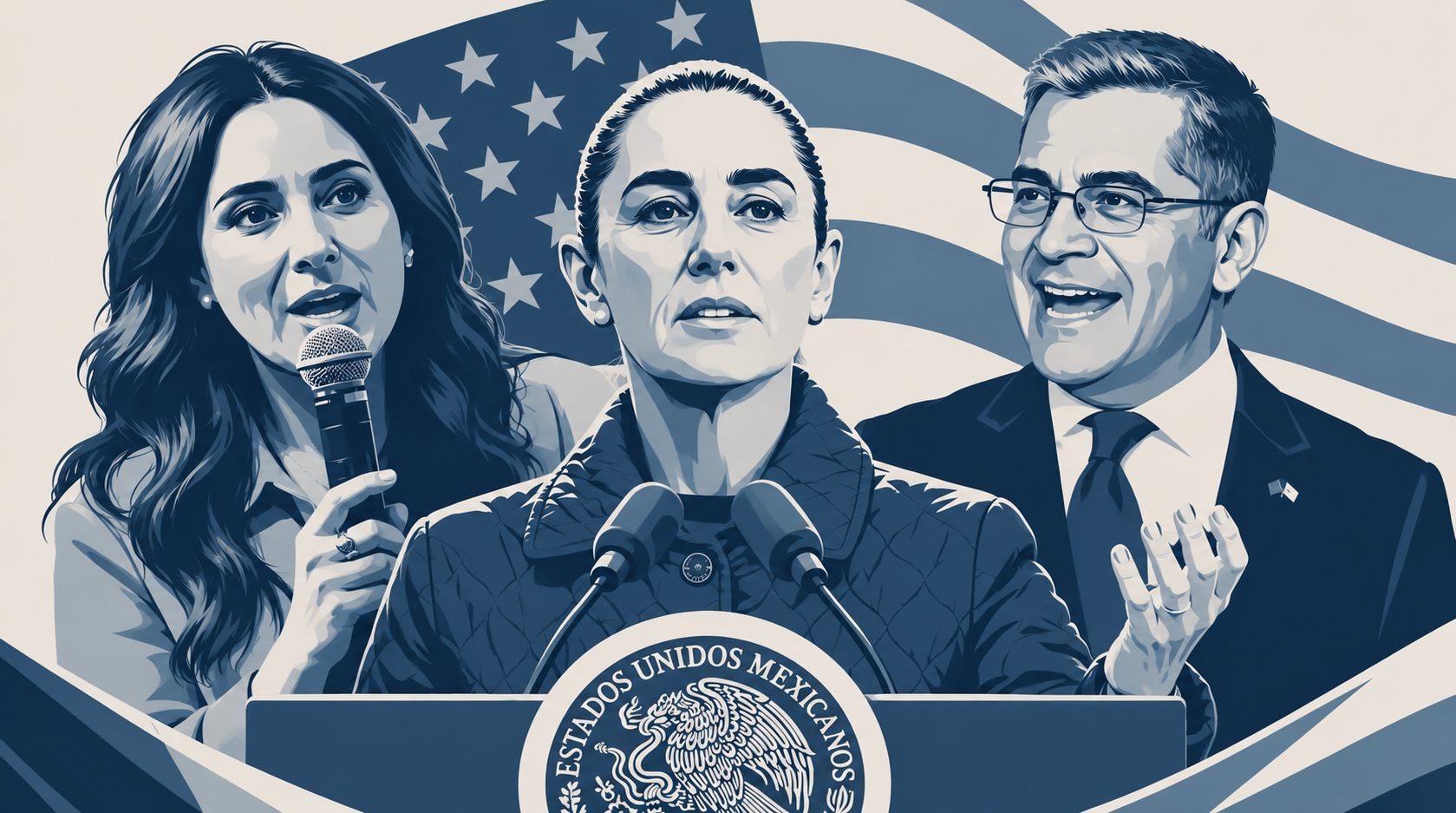
The Taddei case has already outgrown a single INE presidency. The Federal Superior Audit Office (ASF) announced it will review every contract awarded by the institute and by the local electoral bodies between 2000 and 2025, an audit that could reach five INE presidencies. Latinus released new videos in which Taddei and businessman José Alfredo Hernández Casillas go over profit percentages tied to contracts for voter ID cards, one of them worth up to 71 million dollars. The Financial Intelligence Unit (UIF) blocked her accounts and froze another 39 linked to the institute. Resignations number at least 30, and El País revealed that an adviser with no formal position was running INE’s communications and steering contracts to friends and relatives, including her daughter.
At the National Palace and within Morena, the order of the day is to keep their distance. Sheinbaum traced the start of Taddei’s career to 2014, when Lorenzo Córdova headed INE and Morena did not yet exist as a party. Morena’s leadership denied that her appointment as head of the institute was a party designation. With the 2027 electoral process underway, the General Council is preparing external audits of current contracts.
In the United States, Democrats won back both chambers of Congress, and Sheinbaum celebrated the victories of Xavier Becerra in California and Gina Hinojosa in Texas, both of Mexican descent. She was cautious about the impact on the bilateral relationship: she said it is too early to know whether Trump’s stance will change and that the USMCA talks are proceeding as planned.
Criminal violence has municipalities in its sights ahead of 2027. Over two decades, 128 mayors have been murdered, 13 of them so far in the current administration, and the next election will put 17 governorships and 2,230 mayoralties up for grabs. On November 4, in Cuernavaca, Gabriel Rivas Ríos, a Morena city councilor who had reported threats from criminal groups, was shot dead.
The fight over Nuevo León has reached the Attorney General’s Office (FGR). Clara Luz Flores, Morena’s state coordinator, filed a complaint against Samuel García, Mariana Rodríguez and the governor’s father over the alleged triangulation of 7.2 billion pesos to the family’s firms. She also filed a complaint against Adrián de la Garza over the Next Energy contract in Monterrey.
The López Obrador family is back in the headlines. A journalistic investigation points to preferential treatment by the Spanish Consulate in processing Beatriz Gutiérrez Müller’s citizenship application. Andy López Beltrán acknowledged that he knows Amílcar Olán but denied doing business with him, brokering contracts or taking part in any illicit activity. In the Chamber of Deputies, El Universal reported that Morena’s caucus handed its deputies electronic cash cards worth 63.5 million pesos. The party presents it as a legal advance on its public funding, and transparency experts are already comparing it with the Monex case.
Finally, Michoacán ended the avocado strike after three weeks of conflict, and exports resume on November 5. Small growers are still waiting for an answer to their demand for better prices.
The Taddei Network Keeps Taking Its Toll on a Weakened INE
The scandal over the alleged network of irregular contracts during Guadalupe Taddei’s tenure is far from over. The fallout keeps spreading through the National Electoral Institute (INE): resignations of officials tied to her team continue, internal investigations are moving forward, and now the Federal Superior Audit Office (ASF) has announced a review of every contract awarded by the institute and by the local electoral bodies between 2000 and 2025. The inquiry seeks to identify contracting patterns, supplier concentration and possible illegal practices, so the case could extend beyond Taddei’s administration and reach five of the institute’s presidencies.
The scale of the irregularities was also laid bare in the Social Communication area. El País documented that Lourdes Piña Soria del Valle, a Taddei adviser with no formal position at the institute, took part in communications decisions and steered contracts to companies owned by friends and relatives, including one run by her daughter. The Internal Control Body is investigating contract awards for possible conflicts of interest, unjustified services and missing deliverables. On top of this come at least 30 resignations of officials tied to the previous leadership, among them Sergio Uzeta, former head of Social Communication, and Alfonso Burciaga, who was in charge of Material Resources.
The problem now goes beyond an administrative scandal and strikes at the credibility of the electoral referee. The General Council is preparing external audits of current contracts, in addition to requesting an extraordinary audit from the ASF and reviewing possible liabilities. On the eve of the 2027 electoral process, INE faces the challenge of rebuilding its controls, regaining public trust and ensuring the operational continuity of an institution whose autonomy and capacity to organize elections require certainty. The aftermath of the Taddei era remains unresolved, and distrust threatens to become yet another source of institutional erosion.
🔗 Reforma: INE to request external audits over contract scams
Taddei Is Left Alone: the 4T and Sheinbaum Distance Themselves as More Videos Emerge
The crisis surrounding Guadalupe Taddei, former president of INE, is escalating with the release of new videos showing her talking with businessman José Alfredo Hernández Casillas about the alleged sharing of multimillion profits from the electoral body’s contracts. In the recordings, released by Latinus, the two go over figures and percentages related to the production of voter ID cards, authentication services and QR codes. One of the contracts mentioned has a maximum value of 71 million dollars, while the conversation refers to possible profits in the tens of millions. These allegations add to previously released images of the businessman’s ties to Taddei’s relatives and to the investigations into possible irregularities in the institute’s contracting.
Adding to the media and political pressure is the intervention of the Financial Intelligence Unit (UIF), which reportedly blocked Taddei’s bank accounts and froze another 39 linked to INE. The reshuffle within the body is also advancing: 19 senior and mid-level officials tied to her administration have now resigned. Meanwhile, Morena and Claudia Sheinbaum have begun to distance themselves. The president maintained that Taddei’s career in electoral bodies began in 2014, when Lorenzo Córdova headed INE and Morena did not yet exist as a party, while Morena’s leadership said that her appointment as head of the institute was not a party designation. Taddei thus faces the allegations and investigations amid growing political isolation.
🔗 El Universal: Taddei’s accounts blocked; UIF freezes another 39 accounts linked to INE
Mexico Takes Note of Trump’s Electoral Defeat
President Claudia Sheinbaum reacted to the results of the U.S. midterm elections, held on November 3, which marked a setback for Donald Trump and the Republican Party after Democrats regained control of the Senate and the House of Representatives. The president said the results reflect the sentiment of the American people and particularly highlighted the victories of two politicians of Mexican descent: Xavier Becerra, governor-elect of California, and Gina Hinojosa, governor-elect of Texas. Sheinbaum celebrated that Mexican Americans are reaching positions of political representation in states of great importance to the migrant community.
As for possible repercussions for Mexico, the president avoided predicting changes in the bilateral relationship and said it is still too early to determine whether the election result will change Trump’s stance toward the Mexican government. She explained that trade negotiations and the USMCA talks are continuing normally, since they are conducted mainly with the U.S. federal government. She reiterated that Mexico will seek to maintain a good relationship with Washington, based on the principles of respect for sovereignty, territorial integrity and collaboration without subordination.
🔗 Excélsior: Sheinbaum celebrates victory of candidates of Mexican origin in California and Texas
Organized Crime Threatens to Shape the 2027 Elections
Political violence is once again setting off alarms ahead of 2027, with municipal governments as organized crime’s main target. Over the past two decades, 128 mayors have been murdered in Mexico, and during Claudia Sheinbaum’s administration the count already stands at 13. The problem is not limited to killings: criminal groups seek to control territory through threats, extortion, campaign financing, the imposition of candidates and the capture of strategic areas of local government, such as Public Security, Finance and Public Works. The upcoming elections will put 17 governorships and 2,230 mayoralties at stake, a scenario that raises the risk of criminal interference in electoral competition.
Warnings from specialists and organizations such as Data Cívica and Integralia indicate that violence not only shapes campaigns but also seeks to maintain territorial control after the elections. Past cycles offer little encouragement: in 2021 INE documented 30 murders of aspirants, pre-candidates and candidates, while 36 victims were recorded during the 2024 electoral process. Although the federal government has announced protection strategies and Congress approved mechanisms to vet candidates’ backgrounds, the measures are considered insufficient against a threat that endangers the freedom of the vote and municipalities’ ability to govern free of criminal pressure.
🔗 Reforma: Criminal siege of municipalities raises red flags for Mexico’s 2027 elections
Samuel García Under Scrutiny Over Alleged Triangulation of Funds
Accusations of alleged financial irregularities in Nuevo León have escalated to the Attorney General’s Office (FGR). Clara Luz Flores, Morena’s state coordinator, filed complaints against Governor Samuel García, his wife Mariana Rodríguez and his father, Samuel Orlando García Mascorro, over an alleged scheme to triangulate public funds that reportedly channeled some 7.2 billion pesos to law firms linked to the governor’s family. The complaint claims that state government suppliers received public funds and then transferred part of the money to companies connected to García’s family circle.
The accusations add to journalistic investigations by Grupo REFORMA, which documented transfers made within minutes or hours between contractors, intermediaries and Firma Jurídica y Fiscal, the firm of the governor and his father. Among the cases exposed are operations worth 202.9 million pesos by Suministro MYR and transfers of more than 7.4 million pesos from the construction company PILSA. In parallel, Flores filed another complaint against Monterrey Mayor Adrián de la Garza over alleged irregularities in the Next Energy contract, whose potential damage to municipal finances she estimates at 7.37 billion pesos. Both cases put the handling of public funds in the state and municipal governments under scrutiny, although the accusations must still be investigated and proven by the authorities.
🔗 Reforma: Funds triangulated to Samuel… in minutes!
Mexican Avocados: Strike Lifted and Agreement Reached to Resume Exports
After three weeks of conflict, avocado growers, workers and packers in Michoacán reached an agreement to resume harvesting and exports starting November 5. The protest erupted over the collapse in the fruit’s price, which fell to between 13 and 20 pesos per kilo, compared with the 45 pesos small growers were demanding to cover their costs. The strike disrupted the supply chain and sharply reduced shipments to the United States, the main market for Mexican avocados, where exports represent a business worth billions of dollars.
The trade dispute was compounded by a health alert over the detection of avocado seed weevil larvae, which led to the destruction of 52 tons of product in Michoacán and raised concerns about exports. However, Agriculture Secretary Columba López said the pest is not present in Michoacán orchards producing for export and attributed the detected cases to shipments from other states. The agreement allows trade to resume but leaves pending small growers’ demands for fair prices and a more balanced distribution of profits along the agro-export chain.
🔗 Reforma: Agreement reached to resume avocado exports
The López Obrador Family Under Fire Again
The family of former president Andrés Manuel López Obrador is once again at the center of controversy over two matters involving his inner circle. Beatriz Gutiérrez Müller, the former president’s wife, reportedly received preferential treatment at the Spanish Consulate in Mexico when applying for Spanish citizenship. A journalistic investigation indicates that consular officials took steps to obtain documents the historian had allegedly refused to submit, a procedure that would not be standard for other applicants. The application was filed in April 2025 and received the stamp certifying complete documentation that same day.
Separately, Andrés Manuel López Beltrán, known as Andy, broke his silence about his alleged ties to businessman Amílcar Olán, who is accused of obtaining multimillion-peso contracts during his father’s administration and of an alleged connection to fuel tax fraud (huachicol fiscal). The former president’s son acknowledged that he knows the businessman through mutual friends and because Olán’s wife was his elementary school classmate, but denied doing business with him, brokering public contracts or taking part in illicit activities. He alleged a smear campaign against his family and Morena and maintained that no evidence has ever been presented proving his involvement.
🔗 Reforma: AMLO’s wife given VIP treatment for Spanish citizenship
🔗 El Universal: Andy López Beltrán denies ties to Amílcar Olán’s companies
Morena Replicates the Monex Model With Cards for Its Deputies
Morena’s caucus in the Chamber of Deputies handed out Broxel electronic cash cards to its 254 legislators, each loaded with 10,000 pesos. The handout reportedly amounted to a benefit of 50,000 pesos per deputy, equivalent to 63.5 million pesos in total. The cards allow cash withdrawals and purchases and are not subject to expense reporting, which led transparency experts to compare the mechanism with the 2012 Monex case, when the PRI was accused of using prepaid cards to distribute funds during the presidential campaign.
Faced with questions, Morena acknowledged the handout but said it consisted of three cards per legislator, equivalent to 30,000 pesos, and maintained that it is an advance on year-end funding, legal and available to all parliamentary groups. However, legislators from the PAN, PRI, MC, PT and PVEM denied receiving that benefit and demanded clarification of the origin and destination of the funds, as well as an investigation into their distribution.
🔗 El Universal: Morena deputies given cash cards worth 63 million pesos; Monex case recalled
Morena City Councilor Shot Dead in Cuernavaca
Gabriel Rivas Ríos, a Morena councilor on the Cuernavaca City Council, was shot dead on the afternoon of November 4 in the community of Acapantzingo, when armed men on a motorcycle opened fire directly on him as he drove his vehicle. The official had previously reported threats from criminal groups and had clashed with municipal authorities over alleged irregularities, including the spread of clandestine bars and real estate projects he described as part of an alleged “real estate cartel.” Just hours before the attack, he had publicly accused a company of alleged irregular operations. Governor Margarita González Saravia confirmed his death and called for coordination among authorities to solve the homicide. The motive for the crime has not yet been confirmed.
One Year Without Manzo: the Prosecutor’s Office Calls the Case Nearly Solved, and Uruapan Isn’t Buying It
Twelve months after the murder, the Michoacán Prosecutor’s Office reports 34 people detained and 90% progress. Its conclusion is that the crime was CJNG revenge for the capture of one of its local commanders, which leads it to rule out the FGR taking over the case. Among those being prosecuted are the alleged mastermind, alias R1, and his godson, accused of leaking Manzo’s movements; the city’s former security chief remains a fugitive and seven bodyguards are facing charges. Former prosecutor Carlos Torres, who led the initial investigations, is now Morena’s state coordinator, and Leonel Godoy and Raúl Morón appeared as witnesses.
The government responded with figures. Plan Michoacán reports 67% progress and 61% of the 118 billion pesos budgeted for 2025, 2030 spent. Security results will be presented next Tuesday.
🔗 Excélsior: Manzo murder was CJNG revenge; after one year, investigation is 90% complete
Express Opinion
Trump’s Defeat for Mexico, Viridiana Ríos
Viri Ríos considers Donald Trump’s electoral defeat a relief for Mexico but warns that it should not be read as the end of pressure from Washington. She notes that although Democrats could regain control of Congress and constrain the president, some policies enjoy support from both parties and will continue to affect the bilateral relationship, particularly trade protectionism, deportations and border security strategy. She also warns that Trump could react to his defeat by hardening his foreign policy, so Mexico must remain cautious about possible unilateral decisions.
🔗 Milenio: Trump’s defeat for Mexico
Sheinbaum Outlines Profile for INE Successor, Mario Maldonado
Mario Maldonado discusses Claudia Sheinbaum’s search for a nonpartisan, respected and unimpeachable profile to replace Guadalupe Taddei at the head of INE. Among the possible candidates, he mentions Bernardo Valle Monroy, Néstor Vargas Solano and Patricia Avendaño Durán, as well as other profiles with electoral experience. The columnist notes that choosing the successor also opens a political dispute in the Chamber of Deputies, where Ricardo Monreal reportedly has his own proposals. The process unfolds amid the crisis over multimillion-peso contracts, alleged irregularities and possible nepotism networks involving the outgoing administration.
🔗 El Universal: Sheinbaum outlines profile for INE successor
INE: Clean It up or Sink It?, José Carreño Carlón
José Carreño Carlón lays out two scenarios for INE’s future following Guadalupe Taddei’s departure and the allegations of irregularities: seizing the crisis to restore the body’s independence, or using it as an argument to deepen intervention and subordinate it to political power. He revisits the calls by Mauricio Merino, José Medina Mora and José Woldenberg for the renewal of the institute’s presidency to be carried out through consensus among political forces. He also questions Sheinbaum’s remarks about so-called “elite democracy” and warns that the process could weaken electoral autonomy, with consequences for the 2027 elections.
🔗 El Universal: INE: clean it up or sink it?
The Half That Doesn’t Win, Jorge Zepeda Patterson
Jorge Zepeda Patterson argues that recent election results in the United States, Brazil, Israel and other countries do not necessarily represent an ideological shift in those societies, but rather reveal a deep polarization between two blocs that remain virtually intact. He maintains that elections merely determine which half gains power, while the other is sidelined and waits for a chance to reverse the result. Applying this reflection to Mexico, he questions Morena’s reading of its sweeping victory as a blank check to push reforms without agreements with the opposition. He argues that the renewal of INE will be a test for Sheinbaum: proving whether she can build consensus, guarantee institutions that protect minorities and govern for everyone, not only for those who back the ruling party.
🔗 El País: The half that doesn’t win
The Agenda in Brief
· November 5 | The Budget and Public Accounts Committee of the Chamber of Deputies, chaired by Merilyn Gómez Pozos, will be installed to begin reviewing the 2027 Federal Expenditure Budget, whose legal approval deadline is November 14.
· November 6 | Heads of the health sector will appear before the joint Health and Social Security Committees of the Chamber of Deputies. Participants will include Health Secretary David Kershenobich, IMSS Director General Zoé Robledo, ISSSTE head Martí Batres and IMSS-Bienestar Director General Alejandro Svarch.
· November 9 | Active and retired IMSS workers will hold a national mega-march in Mexico City starting at 3:00 p.m., departing from the Centro Médico Nacional Siglo XXI and heading to the capital’s Zócalo.